
- Buy Crypto
- Markets
 Futures
- Spot
- Copy Trade
 Earn
Earn- More
ArkStream Capital: The Power Play of WLFI's CEX-DEX Convergence

Original Article Title: "ArkStream Capital: The Power Play of WLFI and CEX-DEX Integration"
Original Source: ArkStream Capital
Industry Overview
At the beginning of 2025, the cryptocurrency market kicked off amidst a complex mix of optimism and uncertainty. The industry had high hopes for the new year: the potential benefits of the Federal Reserve's shift in monetary policy, the second wave of the AI tech revolution, and the "crypto-friendly" regulatory framework promised by the new U.S. government were all seen as catalysts for industry breakthroughs. However, as the dust settled in the first quarter, the market presented a stark picture of "macro narrative volatility and micro innovation incubation."
The global macroeconomy became the core variable driving market sentiment, with the Federal Reserve struggling to balance inflation concerns and recession risks. The unexpected speculation of a recession interest rate cut in March briefly boosted risk appetite but failed to offset the liquidity panic triggered by the bursting of the U.S. stock market bubble. While the Trump administration fulfilled its election promises by advancing Bitcoin national strategic reserves, digital asset strategic reserves, and enacting the "Digital Asset Regulatory Clarity Act," unlocking structural tailwinds for the industry, the simultaneous presence of policy benefits and lax SEC enforcement intensified the industry's debate over the "compliance transformation cost."
Bitcoin experienced a 30% deep retracement after surpassing the $100,000 historical high in January, exposing the market's profit-taking on the "halving narrative." The altcoin market showed overall subdued performance, but the emergence and delivery of products such as RWAs and user onboarding injected fundamental innovation momentum into the industry. Notably, exchanges like Binance accelerated their DEX ecosystem expansion, facilitating seamless user access to DeFi and other dApps through on-chain liquidity aggregation and account abstraction technology. For the first time, CEX users were allowed to directly trade DEX assets within their accounts, marking a paradigm shift towards "centralization and decentralization integration" that may become a key inflection point for the next cycle of growth and disruption.
Macroeconomic Environment and Impacts
In the first quarter of 2025, the U.S. macroeconomic environment had a profound and complex impact on the cryptocurrency market. For the cryptocurrency market, starting from ETF approval through BTC spot trading, the overall correlation between the crypto market and the U.S. stock market strengthened further, with the Nasdaq's trend to some extent directly determining the direction of the cryptocurrency market. Although BTC was once dubbed "digital gold" in its early years, the cryptocurrency market now leans more towards being a risk asset rather than a safe haven asset, making it more susceptible to market liquidity. ArkStream will continue to monitor trends in the macroeconomy in the future.
At the core of macroeconomics lies the balance between inflation and economic strength, with market trading being based on future expectations: if inflation is too high or the economy is overly robust, the Federal Reserve will tend to postpone interest rate cuts, which is unfavorable for the capital markets; conversely, if the economic performance is too weak, it may pose a risk of recession, which is also detrimental to market confidence and capital flows. Therefore, macroeconomics needs to find a delicate balance between strength and weakness to provide a favorable environment for the capital markets. The DOGE sector's massive layoffs of government agency staff directly led to an increase in the unemployment rate. Meanwhile, Trump's tariff policy, by directly raising prices of affected goods and the costs in related service industries, has exacerbated inflationary pressures and raised the possibility of a U.S. economic recession.
This series of policies has increased market instability, leading to greater volatility in the capital markets. Considering the significant gains brought by the 2024Q4 election season and the potential for substantial market retracements due to short-term market volatility, ArkStream Capital scaled back its investment plans in the 2025Q1 quarter, focusing more time and effort on exploring OTC strategies and expanding channels.
However, considering that such policies may not be merely economic control measures, but rather part of the Trump administration's efforts to increase bargaining chips in political negotiations with other countries, or deliberately create chaos to achieve specific political and economic goals, such as compelling the Federal Reserve to swiftly implement emergency defensive rate cuts by manufacturing signs of economic recession. This would be aimed at achieving a win-win situation in alleviating the U.S. national debt issue and stimulating economic growth and market performance. We still have a positive outlook on the subsequent cryptocurrency market performance.
In the first quarter, the cryptocurrency market showed a high sensitivity to macroeconomic data. The following is a monthly analysis of the market performance in January, February, and March.
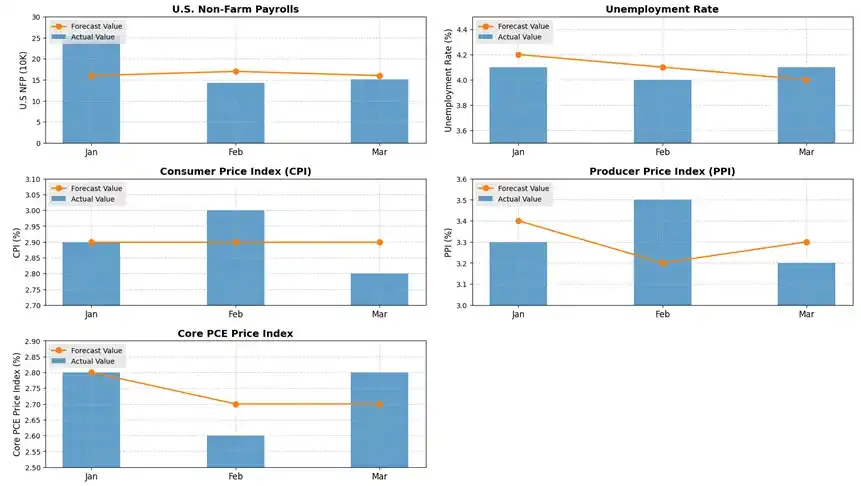
In January, U.S. macroeconomic data was overall strong, but the market reaction was relatively stable. On January 10, the December seasonally adjusted non-farm payrolls data was released, with an expected value of 160,000 and an actual value of 256,000, significantly exceeding market forecasts; on the same day, the December unemployment rate was 4.1%, lower than the expected 4.2%, further confirming the strong economic performance. On January 14, the December PPI year-on-year rate was 3.3%, slightly lower than the expected 3.4%, seen as a signal that short-term inflationary pressures have eased.
However, on January 15, the December non-seasonally adjusted CPI year-on-year rate was 2.9%, meeting expectations but showing a 0.2% increase from the previous month, starting to raise concerns in the market about rising inflation and delayed rate cuts. On January 31, the December core PCE data came in at 2.8%, as expected, and did not significantly disrupt market expectations. Overall, the data for January did not cause significant fluctuations in the cryptocurrency market, as the strong job market and stable inflation data kept asset prices like BTC relatively stable.
Entering February, the cryptocurrency market experienced significant volatility due to the disparity between macroeconomic data and expectations. On February 7, the January seasonally adjusted nonfarm payrolls data was released as 143,000, below the expected 170,000; on the same day, the January unemployment rate was 4.0%, lower than the expected 4.1%. The unclear performance of the job market exacerbated short-term market uncertainty. On February 12, the January non-seasonally adjusted CPI year-on-year rate was announced as 3.0%, higher than the expected 2.9%. With inflation continuing to rise and exceeding expectations, market confidence in rate cuts plummeted. Traders generally bet that rate cuts during the year might only occur once in December, which dealt a significant blow to market sentiment. Following the data release, BTC plummeted by 2500 points within 15 minutes, resulting in a 2.66% drop.
The next day, the January PPI year-on-year rate was revealed to be 3.5%, surpassing the expected 3.2%, further intensifying concerns about a downward revision in rate cut expectations. This was seen as the catalyst for the weakening of buying pressure. Over the following two weeks, BTC dropped by around 20%, plummeting by 20,000 points. It wasn't until February 28 that the January core PCE price index was published as 2.6%, below expectations, that the market stabilized and formed a bottom. It is worth noting that the weakness in the financial and medical services sectors in the PPI data had already provided an early signal for the PCE's decline.
In March, overall improvements in macroeconomic data led to a slight recovery in market sentiment, but the unexpectedly strong performance of the core PCE once again triggered volatility. On March 7, the February seasonally adjusted nonfarm payrolls data was released as 151,000, slightly below the anticipated 160,000; on the same day, the February unemployment rate stood at 4.1%, higher than the expected 4.0%, indicating a slight softness in the job market. On March 12, the February non-seasonally adjusted CPI year-on-year rate was announced as 2.8%, lower than the expected 2.9%; and on March 13, the February PPI year-on-year rate was revealed to be 3.2%, slightly below the expected 3.3%.
This series of data indicates that the economy is running on a solid foundation, inflationary pressures have eased somewhat, and the rate cut process is expected to accelerate. Influenced by this, the cryptocurrency market saw a brief rebound in the following 10 days. However, on March 28, the year-on-year PCE price index for February was reported as 2.5%, meeting expectations, but the core PCE year-on-year rate was 2.8%, higher than the anticipated 2.7%. In the 10 hours leading up to the data release, the market experienced a significant decline due to concerns about the core PCE beating expectations, demonstrating a continued sensitivity to inflation data.
In summary, during the first quarter of 2025, U.S. macroeconomic data had a significant and fluctuating impact on the cryptocurrency market. January saw a strong economy but a subdued market reaction, February witnessed higher-than-expected inflation leading to a sharp drop in rate cut expectations and a substantial BTC decline, and March's economic data improvement drove a brief recovery, yet the higher-than-expected core PCE brought about another downturn. Trump's tariff policy, by exacerbating inflationary pressures, increased market uncertainty and may become a crucial factor compelling the Fed to adjust its policies. Looking ahead, the cryptocurrency market's trajectory will continue to heavily rely on macroeconomic data and the Fed's policy direction. Investors need to closely monitor the dynamics of inflation and employment data to accurately grasp market trends.
Trump Administration's Cryptocurrency Policy and Impact
Trump signed an executive order in March 2025, calling for the establishment of a strategic Bitcoin reserve funded primarily by about 200,000 bitcoins (valued at around $18 billion) seized in criminal or civil forfeitures, and prohibiting the government from selling the bitcoins in the reserve. This action aimed to elevate Bitcoin to a "sovereign reserve asset," enhance its legitimacy and liquidity, and promote the United States' leadership in the digital asset space. While Bitcoin's price surged over 8% in the short term and market confidence increased, the market quickly realized that the reserve relied solely on seized assets with no additional purchase plans, causing the price to plummet.
In the long run, this move may prompt other countries to follow suit, pushing Bitcoin to become an international reserve asset. Additionally, a range of non-Bitcoin digital assets may also have the potential to be included in digital asset reserves. This signifies the transformation of cryptocurrencies from marginal assets to strategic tools of nations. Although the short-term market response was disappointing, its long-term impact could reshape the global financial system: on one hand, driving Bitcoin to become a mainstream reserve asset, and on the other, intensifying sovereign nations' competition in the digital finance sector.
In terms of regulation, Trump, after taking office, pushed for the dismissal of SEC Chairman Gary Gensler and established a cryptocurrency asset task force, clarifying the standards for distinguishing between security and non-security tokens and terminating lawsuits against companies like Coinbase. Furthermore, he repealed the contentious accounting standard SAB 121, alleviating the financial burden on businesses. The regulatory environment significantly relaxed, leading to accelerated entry of institutional investors; traditional financial institutions such as banks were allowed to engage in cryptocurrency custody services, driving the industry's compliance process. This series of regulatory policies, through deregulation, framework restructuring, and legislative advancement, has transformed the ecosystem of the U.S. cryptocurrency and financial industries. In the short term, the policy's dividends may accelerate technological innovation and capital inflows; however, in the long term, vigilance is needed against systemic risks and the complexity of global regulatory gamesmanship. The realization of policy effects in the future will depend on multiple variables, including judicial challenges, economic cycles, and political maneuvering.
In terms of stablecoin development, the Trump administration established a federal regulatory framework for stablecoins, allowing stablecoin issuing institutions to access the Federal Reserve's payment system and explicitly prohibiting the issuance of a central bank digital currency (CBDC) by the Federal Reserve to preserve the innovation space of private cryptocurrencies. The application of stablecoins in cross-border payments accelerated, expanding the path for the internationalization of the U.S. dollar; the market share of private stablecoins expanded, deepening integration with the traditional financial system.
Regarding tariff policies, in February 2025, Trump signed the "Reciprocal Trade and Tariff Memorandum," requiring the tariff rates of the United States' trading partners to be consistent with the United States and imposing tariffs on countries implementing value-added tax systems. This memorandum is a landmark document for adjusting U.S. trade policy, aimed at reducing the U.S. trade deficit, addressing trade inequality and imbalances. Subsequently, Canada, Mexico, the EU, and others quickly took retaliatory measures, leading to the first spiral increase in global tariff barriers. On April 2, 2025, Trump signed an executive order on retaliatory tariffs, further detailing and implementing the policy direction in the February memorandum. The order aimed to reduce the U.S. trade deficit, promote reshoring of manufacturing, and protect the U.S. economy and national security by requiring higher retaliatory tariffs on countries with the largest trade deficits with the United States. This move triggered swift retaliatory actions from the main affected countries, with China taking corresponding measures promptly, formally plunging the economic and trade relations between the two sides into a phase of serious discord and friction.
Under such tariff policies, global trade costs are bound to increase, and the scale of international trade may shrink. Production costs surge, supply chain restructuring accelerates, and corporate investment willingness declines. Most crucially, the United States will have to face the pressure of import-driven inflation. The Federal Reserve's monetary policy finds itself in a dilemma, with rate cut expectations being postponed. The tariff policy also forces companies to shift production to countries like Mexico in Latin America, but issues with domestic infrastructure and labor scarcity in the U.S. hinder the reshoring of manufacturing. Industries relying on global supply chains such as automotive and electronics are severely impacted, multinational corporations face increased profit pressure, and the stock prices of U.S. tech giants experience a pullback.
Emerging markets face challenges in undertaking the industrial chain transfer and are unable to completely fill the demand gap left by the U.S. The trade war has also weakened the trust in the U.S. dollar as the international trade settlement currency, leading to a decline in ten-year Treasury bond prices and a corresponding rise in yields. Behind this is also the Trump administration's consideration to reduce debt expenses and borrowing costs, prompting some countries to begin exploring a path to de-dollarization. In the financial markets, global financial markets, including U.S. stocks, A-shares, Nikkei, etc., have generally experienced significant declines, with market liquidity facing immense pressure.
Trump's cryptocurrency policy, through regulatory easing and strategic reserves, has short-term market confidence and capital inflows, but long-term vigilance is needed against risks of hash rate centralization and policy reversals. While the tariff policy is named "America First," it has led to the fragmentation of the global trade system, raised inflation, exacerbated economic recession expectations, and forced funds to move from risk assets to safe-haven assets like gold. These two major policies together highlight the contradictions and power struggles within the U.S. during the transition between the digital economy and the physical economy.
The DeFi project World Liberty Financial (WLFI) supported by the Trump family, launched in 2024, has had a multidimensional impact on the cryptocurrency industry with its political background and capital operation. WLFI is seen as a "litmus test" for the Trump administration's crypto-friendly policy, and its asset allocation and strategic partnerships are interpreted by the market as a "presidential selection portfolio," attracting investors to follow suit. Short-term actions may exacerbate the market's reliance on the "political narrative" and drive price fluctuations of specific tokens, necessitating long-term vigilance against policy reversals. Additionally, WLFI's USD1 stablecoin released in March 2025 emphasizes compliance and institutional-grade custody. If successfully integrated into cross-border payments and the DeFi scene, it may weaken the market share of existing stablecoins, while advancing the digitization of the dollar and cementing the U.S.'s dominant position in the global financial system.
Furthermore, WLFI's operation benefits from the Trump administration's policy adjustments, providing a compliance template for similar projects, lowering industry compliance thresholds, attracting traditional financial institutions to participate in the crypto business, but potentially leading to market bubbles due to regulatory arbitrage.
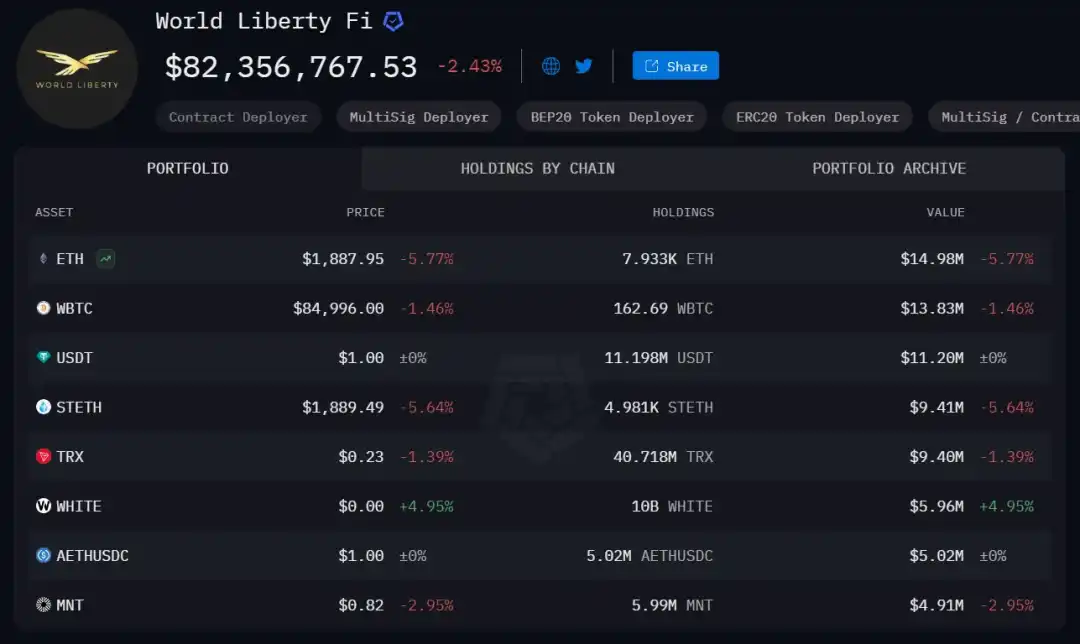
In terms of long-term strategic value, WLFI is heavily invested in various cryptocurrencies such as BTC, ETH, AAVE, ONDO, and ENA, echoing the "Strategic Crypto Reserve" policy promoted by the Trump administration. This positioning may attract more capital to cryptocurrency assets, thereby driving digital asset reserves to become a core narrative in the next cycle. At the same time, WLFI's operating model has provided a "government-business collaboration" reference case for other projects, potentially leading to more politically backed crypto projects in the future. However, a balance between compliance and decentralization principles is necessary.
In summary, WLFI's impact on the cryptocurrency industry has a double-edged sword effect. On the one hand, it accelerates the compliance process through political empowerment, promotes the integration of DeFi and institutional capital, and explores the global application of the USD stablecoin. On the other hand, relying on policy dividends may lead to market bubbles, opaque distribution of benefits may trigger a trust crisis, and poor project execution may become a negative industry example. In the future, it is crucial to focus on WLFI's product implementation progress, the market acceptance of USD1, and the role of the Trump administration's policy consistency in supporting it.
Integration of CEX and DEX
As key entry points into the crypto world, trading platforms and Web3 wallets play a significant role. Users often start their crypto journey on mainstream trading platforms by using fiat currency to top up their assets, engage in cryptocurrency trading, lending, financial activities, or interact with various dApps using Web3 wallets on different blockchains. In the past, the boundary between the two was clear. Due to the high entry barrier and educational cost of Web3 wallets, ordinary users mostly begin their Web3 journey on trading platforms. Centralized trading platforms retain users by offering more mature and widely available services compared to decentralized dApps. Especially by 2025, trading platform businesses are more mature than the previous cycle, with Binance announcing in 2024 that its user base reached 200 million, doubling compared to the previous cycle. In contrast, native Web3 On-Chain users, constrained by various factors, have a daily on-chain activity of only about 10% of centralized trading platforms.
Since 2023, trading platforms have entered the Web3 Wallet product market, leveraging the accumulation and precipitation of assets managed in their trading platform wallets. Among them, OKX Wallet has attracted numerous users at the product level, successfully engaging a large number of users through outstanding user experience in asset management, on-chain interaction, and transaction optimization. CEXs utilize their advantages in the trading platform wallet module, such as building different public chain RPCs, to create more comprehensive and superior wallet products, attracting and retaining users. However, OKX Wallet fundamentally has no significant difference from traditional Web3 wallets; it is merely a more advanced and convenient multi-chain wallet that does not break the usage barrier of native Web3 wallets.
The Binance Web3 Wallet is closely integrated with the trading platform account, initially supporting fast transfers between on-platform assets and Web3 wallets to reduce security concerns for users using Web3 wallets, providing protection from the exchange platform. Additionally, the Binance Web3 ecosystem has launched multiple rounds of IDOs aimed at ordinary users in collaboration with mainstream DEXs, attracting more on-platform users to participate and learn about on-chain knowledge. Furthermore, its latest wallet feature allows on-platform users to directly purchase Alpha series on-chain assets, enabling the direct purchase of on-chain assets from within a CEX, thereby breaking the traditional boundaries between CEXs and DEXs.
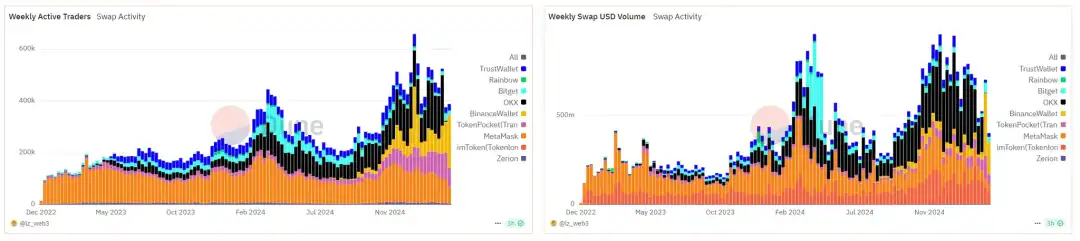
Data Source: Dune, https://dune.com/lz_web3/wallet-war
Unlike mainstream CEX-dominated Web3 Wallets, native crypto projects in the wallet space can focus on the practical and urgent needs of on-chain users. Leveraging years of experience in MPC and account abstraction technology, Particle Network identified the unified account demand driven by cross-chain transactions and introduced UniversalX. This product integrates wallet and trading platform functionalities, effectively addressing the challenges of transferring and trading different chain assets, helping users easily manage assets and conduct efficient transactions in a multi-chain environment. With this innovative product, Particle Network has gained a good reputation and widespread recognition in the market.
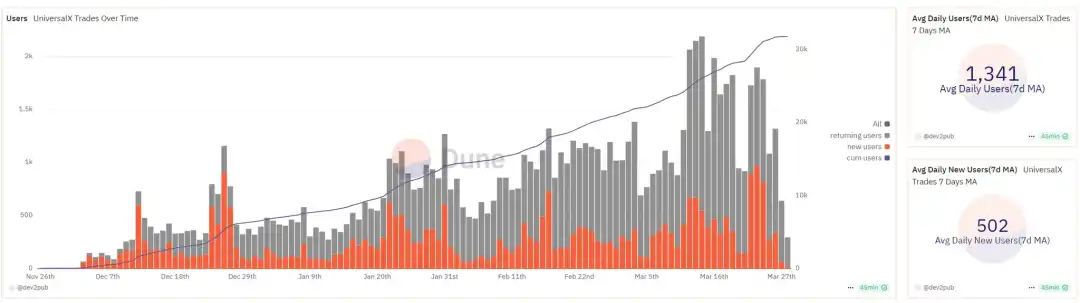
Data Source: Dune
The fusion of CEXs and DEXs is not only a technical innovation but also a milestone in the cryptocurrency market's transition from "oppositional fragmentation" to "collaborative symbiosis." This transformation, while improving efficiency and inclusivity, has also brought about new challenges in regulation, security, and governance. In the future, whoever can better balance centralized efficiency with decentralized asset security and autonomy will lead the evolution of the next-generation financial infrastructure.
Project Investment

SOON
Project Introduction
Soon, through the removal of the governance voting mechanism, enhancing dApps efficiency, integrating a data availability layer, and introducing a fraud-proof mechanism, has restructured and introduced its proprietary Solana Virtual Machine — Soon SVM. This provides an efficient and high-performance scaling solution for mainstream blockchains such as Bitcoin and Ethereum. Building on this foundation, Soon has launched InterSOON to support interoperability between different chains, integrating Jump's high-performance Solana client Firedance. Soon will launch its own SVM network SOON based on the SVM framework and deploy it on multiple public chains such as Bitcoin, Ethereum, TON, and BSC. Through InterSOON, providing internal liquidity pools and interoperability features, Soon achieves seamless asset and data transfers between different blockchains.
Why Invest in Soon
In the current flourishing blockchain ecosystem, the pursuit of high performance has always been a core driving force behind technological innovation. Existing fraud-proof Rollup layer 2 solutions cleverly separate the execution layer from the data availability layer, allowing different components to focus on their respective tasks and laying a solid foundation for improving overall performance. With the increasing maturity of technologies such as EigenDA and Celestia DA, a high-performance execution layer becomes particularly crucial. Among the many projects exploring a high-performance execution layer, projects like Monad and MegaETH focus on the development of a high-performance EVM, while Movement achieves a breakthrough through MoveVM. For Solana, which carries a significant on-chain daily active user base and transaction volume, its SVM has also been a highly successful choice for the execution layer.
However, the native SVM previously had some limitations, such as lack of DA integration support, relatively low efficiency, and inability to accommodate fraud proofs, making it difficult to directly use as an execution layer. Soon astutely identified this pain point and, through the development of Decoupled SVM, successfully added fraud-proof support to the SVM, achieved efficient DA integration, optimized Merkle technology, significantly enhanced security and scalability, and maintained consistency with Ethereum's MPT (Merkle Patricia Trie). This demonstrates Soon's profound technical strength and establishes its position in the high-performance blockchain arena, bringing new technological possibilities and application scenarios to the Solana ecosystem and the entire blockchain industry.
Looking back on the multi-cycle development history of blockchain, Solana has built a large and robust ecosystem thanks to its resilience. Sufficient on-chain funds and numerous active users have provided a solid foundation for Solana's continuous development. As a key component of Solana, SVM is not only the core of its technical architecture but also a symbol of the Solana ecosystem.
Building on SVM, the Soon project can provide extension support for other public chains, unlock more on-chain funds, and attract excellent projects from the Solana ecosystem to build on it. For developers, Soon's high-performance SVM execution layer and mature DA integration solution will significantly reduce development complexity, enhance development efficiency, allowing them to focus more on innovative application development, further enriching the SVM ecosystem, and driving the entire blockchain industry forward.
The development speed of the Soon team is impressive, achieving significant milestones in a mere six months from project initiation. During this time, they not only successfully launched the SOON Devnet and Testnet but also smoothly launched the Mainnet and svmBNB. This series of rapid and solid progress fully demonstrates the team's outstanding development capabilities. Additionally, Soon's Co-builders Round has attracted many well-known project founders to participate, such as Anatoly Yakovenko, co-founder of Solana Labs, and Mustafa AI-Bassam, co-founder of Celestia. This is not only a high recognition of Soon's technical solution but also a strong endorsement of its future development.
Soon upholds a community-centric tokenomics concept, integrating community at the core of the project's development. This concept deeply binds the Soon token with the user community, enabling the community's power, demands, and the project's growth to synergize. In the blockchain industry, the community is one of the project's most valuable assets. An active and loyal community can bring sustained attention, financial support, and valuable feedback to the project. When community members actively participate in project governance, ecosystem development, and other activities, their efforts will influence the project's direction and value.
ArkStream Capital's strategic investment in Soon is a key step in ArkStream Capital's strategic positioning in the Solana ecosystem and SVM field. ArkStream Capital believes that the prosperity of Solana and its SVM ecosystem is one of the undeniable trends in the blockchain industry. ArkStream Capital looks forward to close cooperation with Soon to jointly promote the continuous innovation and development of blockchain technology, and to help the SVM ecosystem move towards a more prosperous future.
Research Reports
ArkStream Capital: 4 Strategic Upgrades Behind Particle: https://mp.weixin.qq.com/s/X5GbpL_yOsnAYtAT9PC6Bw
ArkStream Capital: Crypto's Watershed Year, Embracing the 2025 Carnival: https://mp.weixin.qq.com/s/BSU6CeTZB_dXgvCGX9WbPw
Event Hosting and Participation
Offline Events
Hosted【Hong Kong Consensus】The AI Agent Evolution: https://mp.weixin.qq.com/s/lSw-4YJqTxYXitIY2C6AXg
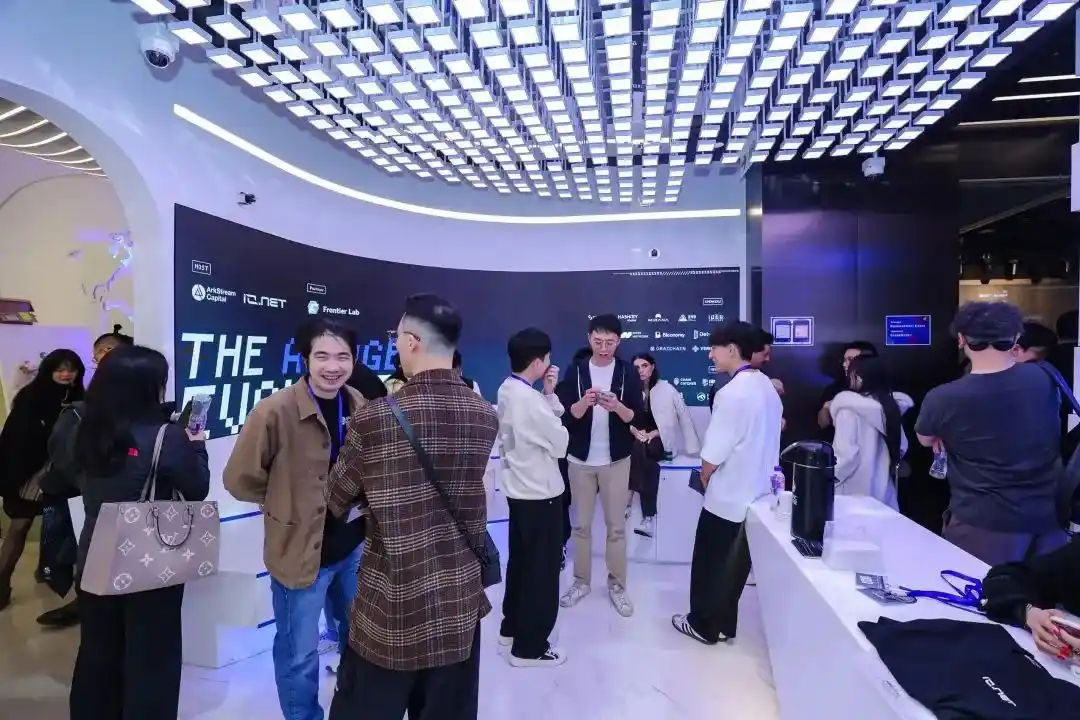
Served as a judge at Aptos' Movemaker Community's【Hacker House Demo Day】: https://x.com/MovemakerCN/status/1903080919780692029

Engaged in discussions on the future of VC with funds like Spartan, Galaxy, Maelstrom, Reciprocal, and others

Online Event
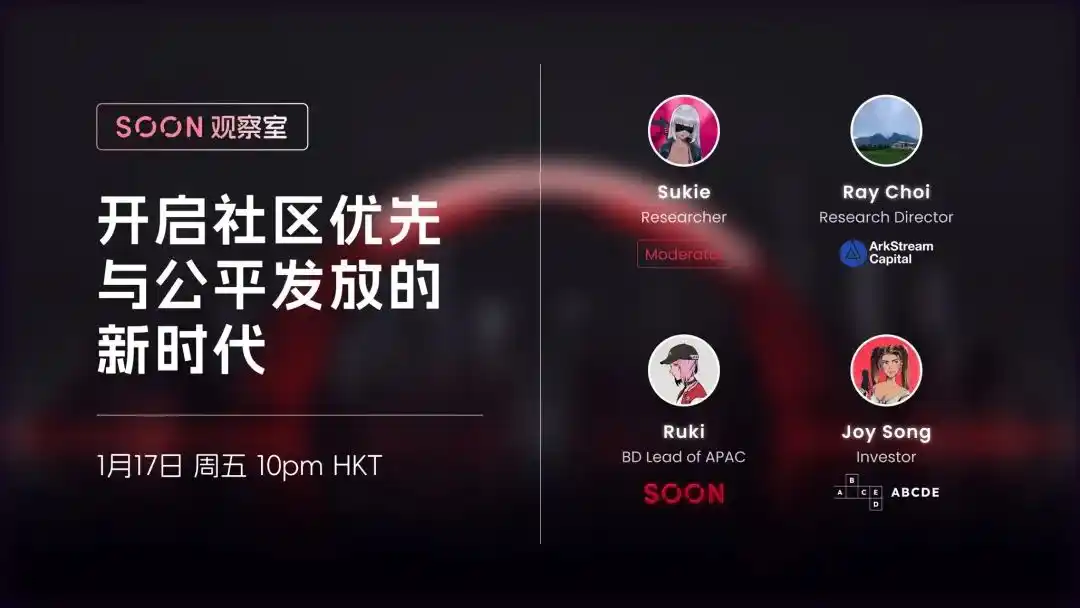
Participated as a guest in SOON's AMA [Initiating a New Era of Community-First and Fair Distribution]: https://x.com/soon_svm/status/1879911091456901512
You may also like

Token Cannot Compound, Where Is the Real Investment Opportunity?

February 6th Market Key Intelligence, How Much Did You Miss?

China's Central Bank and Eight Other Departments' Latest Regulatory Focus: Key Attention to RWA Tokenized Asset Risk
Foreword: Today, the People's Bank of China's website published the "Notice of the People's Bank of China, National Development and Reform Commission, Ministry of Industry and Information Technology, Ministry of Public Security, State Administration for Market Regulation, China Banking and Insurance Regulatory Commission, China Securities Regulatory Commission, State Administration of Foreign Exchange on Further Preventing and Dealing with Risks Related to Virtual Currency and Others (Yinfa [2026] No. 42)", the latest regulatory requirements from the eight departments including the central bank, which are basically consistent with the regulatory requirements of recent years. The main focus of the regulation is on speculative activities such as virtual currency trading, exchanges, ICOs, overseas platform services, and this time, regulatory oversight of RWA has been added, explicitly prohibiting RWA tokenization, stablecoins (especially those pegged to the RMB). The following is the full text:
To the people's governments of all provinces, autonomous regions, and municipalities directly under the Central Government, the Xinjiang Production and Construction Corps:
Recently, there have been speculative activities related to virtual currency and Real-World Assets (RWA) tokenization, disrupting the economic and financial order and jeopardizing the property security of the people. In order to further prevent and address the risks related to virtual currency and Real-World Assets tokenization, effectively safeguard national security and social stability, in accordance with the "Law of the People's Republic of China on the People's Bank of China," "Law of the People's Republic of China on Commercial Banks," "Securities Law of the People's Republic of China," "Law of the People's Republic of China on Securities Investment Funds," "Law of the People's Republic of China on Futures and Derivatives," "Cybersecurity Law of the People's Republic of China," "Regulations of the People's Republic of China on the Administration of Renminbi," "Regulations on Prevention and Disposal of Illegal Fundraising," "Regulations of the People's Republic of China on Foreign Exchange Administration," "Telecommunications Regulations of the People's Republic of China," and other provisions, after reaching consensus with the Cyberspace Administration of China, the Supreme People's Court, and the Supreme People's Procuratorate, and with the approval of the State Council, the relevant matters are notified as follows:
(I) Virtual currency does not possess the legal status equivalent to fiat currency. Virtual currencies such as Bitcoin, Ether, Tether, etc., have the main characteristics of being issued by non-monetary authorities, using encryption technology and distributed ledger or similar technology, existing in digital form, etc. They do not have legal tender status, should not and cannot be circulated and used as currency in the market.
The business activities related to virtual currency are classified as illegal financial activities. The exchange of fiat currency and virtual currency within the territory, exchange of virtual currencies, acting as a central counterparty in buying and selling virtual currencies, providing information intermediary and pricing services for virtual currency transactions, token issuance financing, and trading of virtual currency-related financial products, etc., fall under illegal financial activities, such as suspected illegal issuance of token vouchers, unauthorized public issuance of securities, illegal operation of securities and futures business, illegal fundraising, etc., are strictly prohibited across the board and resolutely banned in accordance with the law. Overseas entities and individuals are not allowed to provide virtual currency-related services to domestic entities in any form.
A stablecoin pegged to a fiat currency indirectly fulfills some functions of the fiat currency in circulation. Without the consent of relevant authorities in accordance with the law and regulations, any domestic or foreign entity or individual is not allowed to issue a RMB-pegged stablecoin overseas.
(II)Tokenization of Real-World Assets refers to the use of encryption technology and distributed ledger or similar technologies to transform ownership rights, income rights, etc., of assets into tokens (tokens) or other interests or bond certificates with token (token) characteristics, and carry out issuance and trading activities.
Engaging in the tokenization of real-world assets domestically, as well as providing related intermediary, information technology services, etc., which are suspected of illegal issuance of token vouchers, unauthorized public offering of securities, illegal operation of securities and futures business, illegal fundraising, and other illegal financial activities, shall be prohibited; except for relevant business activities carried out with the approval of the competent authorities in accordance with the law and regulations and relying on specific financial infrastructures. Overseas entities and individuals are not allowed to illegally provide services related to the tokenization of real-world assets to domestic entities in any form.
(III) Inter-agency Coordination. The People's Bank of China, together with the National Development and Reform Commission, the Ministry of Industry and Information Technology, the Ministry of Public Security, the State Administration for Market Regulation, the China Banking and Insurance Regulatory Commission, the China Securities Regulatory Commission, the State Administration of Foreign Exchange, and other departments, will improve the work mechanism, strengthen coordination with the Cyberspace Administration of China, the Supreme People's Court, and the Supreme People's Procuratorate, coordinate efforts, and overall guide regions to carry out risk prevention and disposal of virtual currency-related illegal financial activities.
The China Securities Regulatory Commission, together with the National Development and Reform Commission, the Ministry of Industry and Information Technology, the Ministry of Public Security, the People's Bank of China, the State Administration for Market Regulation, the China Banking and Insurance Regulatory Commission, the State Administration of Foreign Exchange, and other departments, will improve the work mechanism, strengthen coordination with the Cyberspace Administration of China, the Supreme People's Court, and the Supreme People's Procuratorate, coordinate efforts, and overall guide regions to carry out risk prevention and disposal of illegal financial activities related to the tokenization of real-world assets.
(IV) Strengthening Local Implementation. The people's governments at the provincial level are overall responsible for the prevention and disposal of risks related to virtual currencies and the tokenization of real-world assets in their respective administrative regions. The specific leading department is the local financial regulatory department, with participation from branches and dispatched institutions of the State Council's financial regulatory department, telecommunications regulators, public security, market supervision, and other departments, in coordination with cyberspace departments, courts, and procuratorates, to improve the normalization of the work mechanism, effectively connect with the relevant work mechanisms of central departments, form a cooperative and coordinated working pattern between central and local governments, effectively prevent and properly handle risks related to virtual currencies and the tokenization of real-world assets, and maintain economic and financial order and social stability.
(5) Enhanced Risk Monitoring. The People's Bank of China, China Securities Regulatory Commission, National Development and Reform Commission, Ministry of Industry and Information Technology, Ministry of Public Security, State Administration of Foreign Exchange, Cyberspace Administration of China, and other departments continue to improve monitoring techniques and system support, enhance cross-departmental data analysis and sharing, establish sound information sharing and cross-validation mechanisms, promptly grasp the risk situation of activities related to virtual currency and real-world asset tokenization. Local governments at all levels give full play to the role of local monitoring and early warning mechanisms. Local financial regulatory authorities, together with branches and agencies of the State Council's financial regulatory authorities, as well as departments of cyberspace and public security, ensure effective connection between online monitoring, offline investigation, and fund tracking, efficiently and accurately identify activities related to virtual currency and real-world asset tokenization, promptly share risk information, improve early warning information dissemination, verification, and rapid response mechanisms.
(6) Strengthened Oversight of Financial Institutions, Intermediaries, and Technology Service Providers. Financial institutions (including non-bank payment institutions) are prohibited from providing account opening, fund transfer, and clearing services for virtual currency-related business activities, issuing and selling financial products related to virtual currency, including virtual currency and related financial products in the scope of collateral, conducting insurance business related to virtual currency, or including virtual currency in the scope of insurance liability. Financial institutions (including non-bank payment institutions) are prohibited from providing custody, clearing, and settlement services for unauthorized real-world asset tokenization-related business and related financial products. Relevant intermediary institutions and information technology service providers are prohibited from providing intermediary, technical, or other services for unauthorized real-world asset tokenization-related businesses and related financial products.
(7) Enhanced Management of Internet Information Content and Access. Internet enterprises are prohibited from providing online business venues, commercial displays, marketing, advertising, or paid traffic diversion services for virtual currency and real-world asset tokenization-related business activities. Upon discovering clues of illegal activities, they should promptly report to relevant departments and provide technical support and assistance for related investigations and inquiries. Based on the clues transferred by the financial regulatory authorities, the cyberspace administration, telecommunications authorities, and public security departments should promptly close and deal with websites, mobile applications (including mini-programs), and public accounts engaged in virtual currency and real-world asset tokenization-related business activities in accordance with the law.
(8) Strengthened Entity Registration and Advertisement Management. Market supervision departments strengthen entity registration and management, and enterprise and individual business registrations must not contain terms such as "virtual currency," "virtual asset," "cryptocurrency," "crypto asset," "stablecoin," "real-world asset tokenization," or "RWA" in their names or business scopes. Market supervision departments, together with financial regulatory authorities, legally enhance the supervision of advertisements related to virtual currency and real-world asset tokenization, promptly investigating and handling relevant illegal advertisements.
(IX) Continued Rectification of Virtual Currency Mining Activities. The National Development and Reform Commission, together with relevant departments, strictly controls virtual currency mining activities, continuously promotes the rectification of virtual currency mining activities. The people's governments of various provinces take overall responsibility for the rectification of "mining" within their respective administrative regions. In accordance with the requirements of the National Development and Reform Commission and other departments in the "Notice on the Rectification of Virtual Currency Mining Activities" (NDRC Energy-saving Building [2021] No. 1283) and the provisions of the "Guidance Catalog for Industrial Structure Adjustment (2024 Edition)," a comprehensive review, investigation, and closure of existing virtual currency mining projects are conducted, new mining projects are strictly prohibited, and mining machine production enterprises are strictly prohibited from providing mining machine sales and other services within the country.
(X) Severe Crackdown on Related Illegal Financial Activities. Upon discovering clues to illegal financial activities related to virtual currency and the tokenization of real-world assets, local financial regulatory authorities, branches of the State Council's financial regulatory authorities, and other relevant departments promptly investigate, determine, and properly handle the issues in accordance with the law, and seriously hold the relevant entities and individuals legally responsible. Those suspected of crimes are transferred to the judicial authorities for processing according to the law.
(XI) Severe Crackdown on Related Illegal and Criminal Activities. The Ministry of Public Security, the People's Bank of China, the State Administration for Market Regulation, the China Banking and Insurance Regulatory Commission, the China Securities Regulatory Commission, as well as judicial and procuratorial organs, in accordance with their respective responsibilities, rigorously crack down on illegal and criminal activities related to virtual currency, the tokenization of real-world assets, such as fraud, money laundering, illegal business operations, pyramid schemes, illegal fundraising, and other illegal and criminal activities carried out under the guise of virtual currency, the tokenization of real-world assets, etc.
(XII) Strengthen Industry Self-discipline. Relevant industry associations should enhance membership management and policy advocacy, based on their own responsibilities, advocate and urge member units to resist illegal financial activities related to virtual currency and the tokenization of real-world assets. Member units that violate regulatory policies and industry self-discipline rules are to be disciplined in accordance with relevant self-regulatory management regulations. By leveraging various industry infrastructure, conduct risk monitoring related to virtual currency, the tokenization of real-world assets, and promptly transfer issue clues to relevant departments.
(XIII) Without the approval of relevant departments in accordance with the law and regulations, domestic entities and foreign entities controlled by them may not issue virtual currency overseas.
(XIV) Domestic entities engaging directly or indirectly in overseas external debt-based tokenization of real-world assets, or conducting asset securitization activities abroad based on domestic ownership rights, income rights, etc. (hereinafter referred to as domestic equity), should be strictly regulated in accordance with the principles of "same business, same risk, same rules." The National Development and Reform Commission, the China Securities Regulatory Commission, the State Administration of Foreign Exchange, and other relevant departments regulate it according to their respective responsibilities. For other forms of overseas real-world asset tokenization activities based on domestic equity by domestic entities, the China Securities Regulatory Commission, together with relevant departments, supervise according to their division of responsibilities. Without the consent and filing of relevant departments, no unit or individual may engage in the above-mentioned business.
(15) Overseas subsidiaries and branches of domestic financial institutions providing Real World Asset Tokenization-related services overseas shall do so legally and prudently. They shall have professional personnel and systems in place to effectively mitigate business risks, strictly implement customer onboarding, suitability management, anti-money laundering requirements, and incorporate them into the domestic financial institutions' compliance and risk management system. Intermediaries and information technology service providers offering Real World Asset Tokenization services abroad based on domestic equity or conducting Real World Asset Tokenization business in the form of overseas debt for domestic entities directly or indirectly venturing abroad must strictly comply with relevant laws and regulations. They should establish and improve relevant compliance and internal control systems in accordance with relevant normative requirements, strengthen business and risk control, and report the business developments to the relevant regulatory authorities for approval or filing.
(16) Strengthen organizational leadership and overall coordination. All departments and regions should attach great importance to the prevention of risks related to virtual currencies and Real World Asset Tokenization, strengthen organizational leadership, clarify work responsibilities, form a long-term effective working mechanism with centralized coordination, local implementation, and shared responsibilities, maintain high pressure, dynamically monitor risks, effectively prevent and mitigate risks in an orderly and efficient manner, legally protect the property security of the people, and make every effort to maintain economic and financial order and social stability.
(17) Widely carry out publicity and education. All departments, regions, and industry associations should make full use of various media and other communication channels to disseminate information through legal and policy interpretation, analysis of typical cases, and education on investment risks, etc. They should promote the illegality and harm of virtual currencies and Real World Asset Tokenization-related businesses and their manifestations, fully alert to potential risks and hidden dangers, and enhance public awareness and identification capabilities for risk prevention.
(18) Engaging in illegal financial activities related to virtual currencies and Real World Asset Tokenization in violation of this notice, as well as providing services for virtual currencies and Real World Asset Tokenization-related businesses, shall be punished in accordance with relevant regulations. If it constitutes a crime, criminal liability shall be pursued according to the law. For domestic entities and individuals who knowingly or should have known that overseas entities illegally provided virtual currency or Real World Asset Tokenization-related services to domestic entities and still assisted them, relevant responsibilities shall be pursued according to the law. If it constitutes a crime, criminal liability shall be pursued according to the law.
(19) If any unit or individual invests in virtual currencies, Real World Asset Tokens, and related financial products against public order and good customs, the relevant civil legal actions shall be invalid, and any resulting losses shall be borne by them. If there are suspicions of disrupting financial order and jeopardizing financial security, the relevant departments shall deal with them according to the law.
This notice shall enter into force upon the date of its issuance. The People's Bank of China and ten other departments' "Notice on Further Preventing and Dealing with the Risks of Virtual Currency Trading Speculation" (Yinfa [2021] No. 237) is hereby repealed.

Former Partner's Perspective on Multicoin: Kyle's Exit, But the Game He Left Behind Just Getting Started
Why Bitcoin Is Falling Now: The Real Reasons Behind BTC's Crash & WEEX's Smart Profit Playbook
Bitcoin's ongoing crash explained: Discover the 5 hidden triggers behind BTC's plunge & how WEEX's Auto Earn and Trade to Earn strategies help traders profit from crypto market volatility.

Wall Street's Hottest Trades See Exodus

Vitalik Discusses Ethereum Scaling Path, Circle Announces Partnership with Polymarket, What's the Overseas Crypto Community Talking About Today?

Believing in the Capital Markets - The Essence and Core Value of Cryptocurrency

Polymarket's 'Weatherman': Predict Temperature, Win Million-Dollar Payout

$15K+ Profits: The 4 AI Trading Secrets WEEX Hackathon Prelim Winners Used to Dominate Volatile Crypto Markets
How WEEX Hackathon's top AI trading strategies made $15K+ in crypto markets: 4 proven rules for ETH/BTC trading, market structure analysis, and risk management in volatile conditions.

A nearly 20% one-day plunge, how long has it been since you last saw a $60,000 Bitcoin?

Raoul Pal: I've seen every single panic, and they are never the end.

Key Market Information Discrepancy on February 6th - A Must-Read! | Alpha Morning Report

2026 Crypto Industry's First Snowfall
The Harsh Reality Behind the $26 Billion Crypto Liquidation: Liquidity Is Killing the Market
Why Is Gold, US Stocks, Bitcoin All Falling?

Key Market Intelligence for February 5th, how much did you miss out on?

Wintermute: By 2026, crypto had gradually become the settlement layer of the Internet economy
Token Cannot Compound, Where Is the Real Investment Opportunity?
February 6th Market Key Intelligence, How Much Did You Miss?
China's Central Bank and Eight Other Departments' Latest Regulatory Focus: Key Attention to RWA Tokenized Asset Risk
Foreword: Today, the People's Bank of China's website published the "Notice of the People's Bank of China, National Development and Reform Commission, Ministry of Industry and Information Technology, Ministry of Public Security, State Administration for Market Regulation, China Banking and Insurance Regulatory Commission, China Securities Regulatory Commission, State Administration of Foreign Exchange on Further Preventing and Dealing with Risks Related to Virtual Currency and Others (Yinfa [2026] No. 42)", the latest regulatory requirements from the eight departments including the central bank, which are basically consistent with the regulatory requirements of recent years. The main focus of the regulation is on speculative activities such as virtual currency trading, exchanges, ICOs, overseas platform services, and this time, regulatory oversight of RWA has been added, explicitly prohibiting RWA tokenization, stablecoins (especially those pegged to the RMB). The following is the full text:
To the people's governments of all provinces, autonomous regions, and municipalities directly under the Central Government, the Xinjiang Production and Construction Corps:
Recently, there have been speculative activities related to virtual currency and Real-World Assets (RWA) tokenization, disrupting the economic and financial order and jeopardizing the property security of the people. In order to further prevent and address the risks related to virtual currency and Real-World Assets tokenization, effectively safeguard national security and social stability, in accordance with the "Law of the People's Republic of China on the People's Bank of China," "Law of the People's Republic of China on Commercial Banks," "Securities Law of the People's Republic of China," "Law of the People's Republic of China on Securities Investment Funds," "Law of the People's Republic of China on Futures and Derivatives," "Cybersecurity Law of the People's Republic of China," "Regulations of the People's Republic of China on the Administration of Renminbi," "Regulations on Prevention and Disposal of Illegal Fundraising," "Regulations of the People's Republic of China on Foreign Exchange Administration," "Telecommunications Regulations of the People's Republic of China," and other provisions, after reaching consensus with the Cyberspace Administration of China, the Supreme People's Court, and the Supreme People's Procuratorate, and with the approval of the State Council, the relevant matters are notified as follows:
(I) Virtual currency does not possess the legal status equivalent to fiat currency. Virtual currencies such as Bitcoin, Ether, Tether, etc., have the main characteristics of being issued by non-monetary authorities, using encryption technology and distributed ledger or similar technology, existing in digital form, etc. They do not have legal tender status, should not and cannot be circulated and used as currency in the market.
The business activities related to virtual currency are classified as illegal financial activities. The exchange of fiat currency and virtual currency within the territory, exchange of virtual currencies, acting as a central counterparty in buying and selling virtual currencies, providing information intermediary and pricing services for virtual currency transactions, token issuance financing, and trading of virtual currency-related financial products, etc., fall under illegal financial activities, such as suspected illegal issuance of token vouchers, unauthorized public issuance of securities, illegal operation of securities and futures business, illegal fundraising, etc., are strictly prohibited across the board and resolutely banned in accordance with the law. Overseas entities and individuals are not allowed to provide virtual currency-related services to domestic entities in any form.
A stablecoin pegged to a fiat currency indirectly fulfills some functions of the fiat currency in circulation. Without the consent of relevant authorities in accordance with the law and regulations, any domestic or foreign entity or individual is not allowed to issue a RMB-pegged stablecoin overseas.
(II)Tokenization of Real-World Assets refers to the use of encryption technology and distributed ledger or similar technologies to transform ownership rights, income rights, etc., of assets into tokens (tokens) or other interests or bond certificates with token (token) characteristics, and carry out issuance and trading activities.
Engaging in the tokenization of real-world assets domestically, as well as providing related intermediary, information technology services, etc., which are suspected of illegal issuance of token vouchers, unauthorized public offering of securities, illegal operation of securities and futures business, illegal fundraising, and other illegal financial activities, shall be prohibited; except for relevant business activities carried out with the approval of the competent authorities in accordance with the law and regulations and relying on specific financial infrastructures. Overseas entities and individuals are not allowed to illegally provide services related to the tokenization of real-world assets to domestic entities in any form.
(III) Inter-agency Coordination. The People's Bank of China, together with the National Development and Reform Commission, the Ministry of Industry and Information Technology, the Ministry of Public Security, the State Administration for Market Regulation, the China Banking and Insurance Regulatory Commission, the China Securities Regulatory Commission, the State Administration of Foreign Exchange, and other departments, will improve the work mechanism, strengthen coordination with the Cyberspace Administration of China, the Supreme People's Court, and the Supreme People's Procuratorate, coordinate efforts, and overall guide regions to carry out risk prevention and disposal of virtual currency-related illegal financial activities.
The China Securities Regulatory Commission, together with the National Development and Reform Commission, the Ministry of Industry and Information Technology, the Ministry of Public Security, the People's Bank of China, the State Administration for Market Regulation, the China Banking and Insurance Regulatory Commission, the State Administration of Foreign Exchange, and other departments, will improve the work mechanism, strengthen coordination with the Cyberspace Administration of China, the Supreme People's Court, and the Supreme People's Procuratorate, coordinate efforts, and overall guide regions to carry out risk prevention and disposal of illegal financial activities related to the tokenization of real-world assets.
(IV) Strengthening Local Implementation. The people's governments at the provincial level are overall responsible for the prevention and disposal of risks related to virtual currencies and the tokenization of real-world assets in their respective administrative regions. The specific leading department is the local financial regulatory department, with participation from branches and dispatched institutions of the State Council's financial regulatory department, telecommunications regulators, public security, market supervision, and other departments, in coordination with cyberspace departments, courts, and procuratorates, to improve the normalization of the work mechanism, effectively connect with the relevant work mechanisms of central departments, form a cooperative and coordinated working pattern between central and local governments, effectively prevent and properly handle risks related to virtual currencies and the tokenization of real-world assets, and maintain economic and financial order and social stability.
(5) Enhanced Risk Monitoring. The People's Bank of China, China Securities Regulatory Commission, National Development and Reform Commission, Ministry of Industry and Information Technology, Ministry of Public Security, State Administration of Foreign Exchange, Cyberspace Administration of China, and other departments continue to improve monitoring techniques and system support, enhance cross-departmental data analysis and sharing, establish sound information sharing and cross-validation mechanisms, promptly grasp the risk situation of activities related to virtual currency and real-world asset tokenization. Local governments at all levels give full play to the role of local monitoring and early warning mechanisms. Local financial regulatory authorities, together with branches and agencies of the State Council's financial regulatory authorities, as well as departments of cyberspace and public security, ensure effective connection between online monitoring, offline investigation, and fund tracking, efficiently and accurately identify activities related to virtual currency and real-world asset tokenization, promptly share risk information, improve early warning information dissemination, verification, and rapid response mechanisms.
(6) Strengthened Oversight of Financial Institutions, Intermediaries, and Technology Service Providers. Financial institutions (including non-bank payment institutions) are prohibited from providing account opening, fund transfer, and clearing services for virtual currency-related business activities, issuing and selling financial products related to virtual currency, including virtual currency and related financial products in the scope of collateral, conducting insurance business related to virtual currency, or including virtual currency in the scope of insurance liability. Financial institutions (including non-bank payment institutions) are prohibited from providing custody, clearing, and settlement services for unauthorized real-world asset tokenization-related business and related financial products. Relevant intermediary institutions and information technology service providers are prohibited from providing intermediary, technical, or other services for unauthorized real-world asset tokenization-related businesses and related financial products.
(7) Enhanced Management of Internet Information Content and Access. Internet enterprises are prohibited from providing online business venues, commercial displays, marketing, advertising, or paid traffic diversion services for virtual currency and real-world asset tokenization-related business activities. Upon discovering clues of illegal activities, they should promptly report to relevant departments and provide technical support and assistance for related investigations and inquiries. Based on the clues transferred by the financial regulatory authorities, the cyberspace administration, telecommunications authorities, and public security departments should promptly close and deal with websites, mobile applications (including mini-programs), and public accounts engaged in virtual currency and real-world asset tokenization-related business activities in accordance with the law.
(8) Strengthened Entity Registration and Advertisement Management. Market supervision departments strengthen entity registration and management, and enterprise and individual business registrations must not contain terms such as "virtual currency," "virtual asset," "cryptocurrency," "crypto asset," "stablecoin," "real-world asset tokenization," or "RWA" in their names or business scopes. Market supervision departments, together with financial regulatory authorities, legally enhance the supervision of advertisements related to virtual currency and real-world asset tokenization, promptly investigating and handling relevant illegal advertisements.
(IX) Continued Rectification of Virtual Currency Mining Activities. The National Development and Reform Commission, together with relevant departments, strictly controls virtual currency mining activities, continuously promotes the rectification of virtual currency mining activities. The people's governments of various provinces take overall responsibility for the rectification of "mining" within their respective administrative regions. In accordance with the requirements of the National Development and Reform Commission and other departments in the "Notice on the Rectification of Virtual Currency Mining Activities" (NDRC Energy-saving Building [2021] No. 1283) and the provisions of the "Guidance Catalog for Industrial Structure Adjustment (2024 Edition)," a comprehensive review, investigation, and closure of existing virtual currency mining projects are conducted, new mining projects are strictly prohibited, and mining machine production enterprises are strictly prohibited from providing mining machine sales and other services within the country.
(X) Severe Crackdown on Related Illegal Financial Activities. Upon discovering clues to illegal financial activities related to virtual currency and the tokenization of real-world assets, local financial regulatory authorities, branches of the State Council's financial regulatory authorities, and other relevant departments promptly investigate, determine, and properly handle the issues in accordance with the law, and seriously hold the relevant entities and individuals legally responsible. Those suspected of crimes are transferred to the judicial authorities for processing according to the law.
(XI) Severe Crackdown on Related Illegal and Criminal Activities. The Ministry of Public Security, the People's Bank of China, the State Administration for Market Regulation, the China Banking and Insurance Regulatory Commission, the China Securities Regulatory Commission, as well as judicial and procuratorial organs, in accordance with their respective responsibilities, rigorously crack down on illegal and criminal activities related to virtual currency, the tokenization of real-world assets, such as fraud, money laundering, illegal business operations, pyramid schemes, illegal fundraising, and other illegal and criminal activities carried out under the guise of virtual currency, the tokenization of real-world assets, etc.
(XII) Strengthen Industry Self-discipline. Relevant industry associations should enhance membership management and policy advocacy, based on their own responsibilities, advocate and urge member units to resist illegal financial activities related to virtual currency and the tokenization of real-world assets. Member units that violate regulatory policies and industry self-discipline rules are to be disciplined in accordance with relevant self-regulatory management regulations. By leveraging various industry infrastructure, conduct risk monitoring related to virtual currency, the tokenization of real-world assets, and promptly transfer issue clues to relevant departments.
(XIII) Without the approval of relevant departments in accordance with the law and regulations, domestic entities and foreign entities controlled by them may not issue virtual currency overseas.
(XIV) Domestic entities engaging directly or indirectly in overseas external debt-based tokenization of real-world assets, or conducting asset securitization activities abroad based on domestic ownership rights, income rights, etc. (hereinafter referred to as domestic equity), should be strictly regulated in accordance with the principles of "same business, same risk, same rules." The National Development and Reform Commission, the China Securities Regulatory Commission, the State Administration of Foreign Exchange, and other relevant departments regulate it according to their respective responsibilities. For other forms of overseas real-world asset tokenization activities based on domestic equity by domestic entities, the China Securities Regulatory Commission, together with relevant departments, supervise according to their division of responsibilities. Without the consent and filing of relevant departments, no unit or individual may engage in the above-mentioned business.
(15) Overseas subsidiaries and branches of domestic financial institutions providing Real World Asset Tokenization-related services overseas shall do so legally and prudently. They shall have professional personnel and systems in place to effectively mitigate business risks, strictly implement customer onboarding, suitability management, anti-money laundering requirements, and incorporate them into the domestic financial institutions' compliance and risk management system. Intermediaries and information technology service providers offering Real World Asset Tokenization services abroad based on domestic equity or conducting Real World Asset Tokenization business in the form of overseas debt for domestic entities directly or indirectly venturing abroad must strictly comply with relevant laws and regulations. They should establish and improve relevant compliance and internal control systems in accordance with relevant normative requirements, strengthen business and risk control, and report the business developments to the relevant regulatory authorities for approval or filing.
(16) Strengthen organizational leadership and overall coordination. All departments and regions should attach great importance to the prevention of risks related to virtual currencies and Real World Asset Tokenization, strengthen organizational leadership, clarify work responsibilities, form a long-term effective working mechanism with centralized coordination, local implementation, and shared responsibilities, maintain high pressure, dynamically monitor risks, effectively prevent and mitigate risks in an orderly and efficient manner, legally protect the property security of the people, and make every effort to maintain economic and financial order and social stability.
(17) Widely carry out publicity and education. All departments, regions, and industry associations should make full use of various media and other communication channels to disseminate information through legal and policy interpretation, analysis of typical cases, and education on investment risks, etc. They should promote the illegality and harm of virtual currencies and Real World Asset Tokenization-related businesses and their manifestations, fully alert to potential risks and hidden dangers, and enhance public awareness and identification capabilities for risk prevention.
(18) Engaging in illegal financial activities related to virtual currencies and Real World Asset Tokenization in violation of this notice, as well as providing services for virtual currencies and Real World Asset Tokenization-related businesses, shall be punished in accordance with relevant regulations. If it constitutes a crime, criminal liability shall be pursued according to the law. For domestic entities and individuals who knowingly or should have known that overseas entities illegally provided virtual currency or Real World Asset Tokenization-related services to domestic entities and still assisted them, relevant responsibilities shall be pursued according to the law. If it constitutes a crime, criminal liability shall be pursued according to the law.
(19) If any unit or individual invests in virtual currencies, Real World Asset Tokens, and related financial products against public order and good customs, the relevant civil legal actions shall be invalid, and any resulting losses shall be borne by them. If there are suspicions of disrupting financial order and jeopardizing financial security, the relevant departments shall deal with them according to the law.
This notice shall enter into force upon the date of its issuance. The People's Bank of China and ten other departments' "Notice on Further Preventing and Dealing with the Risks of Virtual Currency Trading Speculation" (Yinfa [2021] No. 237) is hereby repealed.
Former Partner's Perspective on Multicoin: Kyle's Exit, But the Game He Left Behind Just Getting Started
Why Bitcoin Is Falling Now: The Real Reasons Behind BTC's Crash & WEEX's Smart Profit Playbook
Bitcoin's ongoing crash explained: Discover the 5 hidden triggers behind BTC's plunge & how WEEX's Auto Earn and Trade to Earn strategies help traders profit from crypto market volatility.


 App
App