
Ondo Launches S&P 500 Token With a 100% Downside Buffer: What's the Catch?

 Prefer us on Google

Ondo SPYSHIELDon launched on November 17, 2026, introducing a tokenized S&P 500 investment strategy built from 12 defined-protection ETFs that seek to buffer up to 100% of underlying market losses over specified periods. Unlike a conventional S&P 500 investment, Ondo SPYSHIELDon exchanges unlimited upside potential for capped returns and conditional downside protection. The launch comes as Ondo Intelligent Portfolios surpass $75 million in total value locked, highlighting growing interest in tokenized investment strategies. But does Ondo SPYSHIELDon actually protect investors from losing money? This article examines the portfolio's structure, protection conditions, hidden trade-offs and implications for the ONDO ecosystem.
Key Takeaways
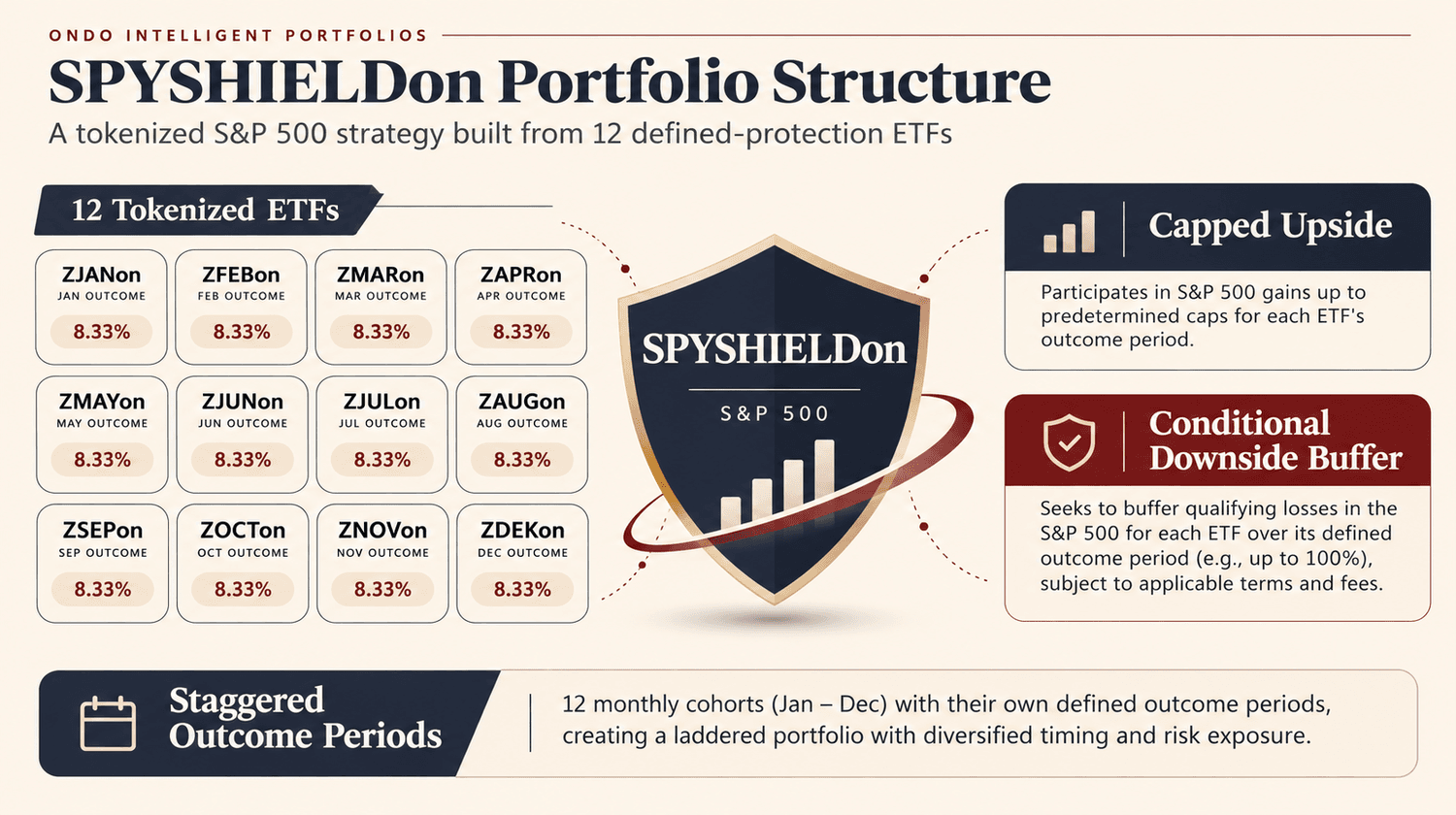
- 12 ETFs in one token: SPYSHIELDon combines 12 tokenized defined-protection ETFs with staggered outcome periods, seeking S&P 500 upside up to predetermined caps while buffering qualifying losses.
- 100% buffer is conditional: The underlying ETFs target protection over their full outcome periods before fees and expenses. This is not an unconditional guarantee against losses in the tokenized portfolio.
- Ondo expands its RWA offerings: The launch brings Ondo Intelligent Portfolios to eight strategies, with more than $75 million in combined TVL as of November 17.
What Is SPYSHIELDon, and Why Did Ondo Launch It?
On November 17, Ondo Finance introduced the Ondo US 500 Capital Shielded Portfolio, known as SPYSHIELDon, as its first defined-outcome investment strategy. The product is designed to give eligible investors exposure to S&P 500 market performance while seeking to reduce losses during periods of falling stock prices.
Traditional S&P 500 investing generally gives investors direct exposure to market gains and losses. If the underlying index rises, an index-tracking investment typically gains value, subject to tracking differences and expenses. If the market declines, the investment normally experiences a corresponding loss.
SPYSHIELDon introduces a different risk-return structure. Rather than seeking unrestricted participation in stock-market gains, the portfolio holds ETFs that use options-based strategies to target an upper limit on returns alongside a specified downside buffer.
The central trade-off is that investors may give up some potential gains in strong markets in exchange for a strategy intended to reduce the impact of declines over defined periods.
SPYSHIELDon Launch: Key Facts
| Category | Confirmed Information |
|---|---|
| Product Name | Ondo US 500 Capital Shielded Portfolio |
| Token Symbol | SPYSHIELDon |
| Launch Date | November 17, 2026 |
| Issuer / Platform | Ondo Finance |
| Underlying Strategy | Defined-outcome S&P 500 exposure |
| Underlying Holdings | 12 tokenized defined-protection ETFs |
| Initial Target Allocation | Equal-weighted, approximately 8.33% each |
| Maximum Underlying Buffer Objective | Up to 100%, subject to outcome-period conditions |
| Upside Potential | Capped at applicable ETF limits |
| Portfolio Management | Programmatic allocation and rebalancing |
| Eligible Investors | Eligible investors outside the United States |
| Supported Ecosystem | Ethereum, BNB Chain and Solana |
| Ondo Intelligent Portfolios | Eight strategies following the launch |
| Combined Portfolio TVL | More than $75 million as of November 17 |
Source: Ondo Finance — New Ondo Intelligent Portfolio: The First Defined Outcome Strategy, November 17, 2026.
The product is part of Ondo's broader effort to move beyond tokenizing individual securities. By packaging several investment positions into a single transferable token, Ondo aims to make structured portfolio strategies accessible through blockchain-based infrastructure.
However, tokenization changes how a portfolio can be held and transferred; it does not eliminate the underlying investment risks. Understanding the product requires examining both the ETF structure and the tokenized portfolio itself.
How Does SPYSHIELDon's 100% Downside Buffer Work?
The phrase "100% downside buffer" is the most attention-grabbing part of Ondo's announcement, but it can easily be misunderstood.
In a defined-protection ETF, a downside buffer describes an investment objective established for a specified outcome period. The ETF typically uses options to seek participation in gains from a reference asset up to a predetermined cap while limiting losses over that period.
For SPYSHIELDon, the underlying reference is the SPDR S&P 500 ETF Trust (SPY), which tracks the performance of the S&P 500.
The underlying ETFs are designed to seek buffers against losses in SPY over their designated one-year periods. However, the protective outcome generally assumes an investment held from the beginning through the end of the relevant outcome period.
An investor buying or selling partway through that period may experience different results.
The Difference Between a Buffer and a Guarantee
| Feature | What It Means | Important Limitation |
|---|---|---|
| 100% Downside Buffer | Seeks to offset losses in the reference ETF over the defined outcome period | Not an unconditional guarantee |
| Upside Cap | Limits the maximum return that can be earned from the underlying ETF's strategy | Investors may miss additional market gains |
| Outcome Period | Establishes the starting and ending dates used to calculate the defined outcome | Entering or exiting early changes the potential result |
| Fund Expenses | Fees and expenses are deducted from investment performance | A buffer does not necessarily protect against all costs |
| Tokenized Portfolio | Combines several ETF-linked holdings into one blockchain-based position | Introduces additional product and infrastructure considerations |
Sources: Ondo Finance official announcement and Innovator Equity Defined Protection ETFs.
The distinction is important because the word "protection" can suggest that investment principal will never decline. That is not what the underlying ETF documents promise.
Innovator, the issuer of the underlying defined-protection ETFs, states that its targeted investment outcomes depend on holding shares across the full applicable outcome period, before fees and expenses. It also cautions that the intended outcomes are not guaranteed.
SPYSHIELDon investors face an additional layer of complexity because the tokenized portfolio combines funds with different start dates, end dates and market values. The portfolio's value can fluctuate before individual ETF outcome periods conclude.
Therefore, an investor should not assume that purchasing SPYSHIELDon today guarantees receiving the original purchase amount back at any future date.
What Happens if the S&P 500 Crashes?
A hypothetical example helps explain why a downside-buffer strategy might appeal to investors during periods of market uncertainty.
Imagine that the S&P 500 falls by 25% during a one-year period. A conventional S&P 500 investment would generally experience a substantial decline, subject to the difference between index performance and the actual investment vehicle.
A defined-protection ETF targeting a 100% buffer would seek to offset the corresponding underlying ETF loss over its full outcome period, before fees and expenses.
However, that outcome depends on the ETF's actual terms, the timing of the investment and the operation of its underlying options strategy.
Simplified S&P 500 Return Scenarios
| S&P 500 Performance | Conventional S&P 500 Exposure | Defined-Protection ETF Objective |
|---|---|---|
| +25% | Generally participates in the gain | Participates only up to its applicable cap |
| +10% | Generally participates in the gain | Gain may be limited by the cap |
| 0% | Approximately flat before expenses | Approximately flat before expenses |
| -10% | Generally experiences a decline | Seeks to buffer the decline |
| -25% | Generally experiences a larger decline | Seeks to buffer the decline |
Note: This table illustrates the general structure of a defined-protection ETF, not actual or guaranteed SPYSHIELDon portfolio returns. Fund expenses, investment timing, market pricing and token-level risks can change realized results.
The downside buffer is therefore best understood as a feature of the underlying investment strategy, not as an unconditional insurance policy.
If an investor buys an ETF after its outcome period has already started, the remaining upside cap and downside buffer may differ from those available at inception. Similarly, selling before the end of the period can expose the investor to unfavorable market pricing.
These issues become particularly relevant in a tokenized portfolio that can be traded or transferred without necessarily waiting for each underlying ETF's outcome date.
-- Price
Why Does SPYSHIELDon Hold 12 Different ETFs?
One of SPYSHIELDon's most distinctive features is its equal-weighted exposure to 12 defined-protection ETFs, each associated with a different starting month.
Rather than relying on a single ETF with one annual outcome period, the portfolio spreads its exposure across 12 separate monthly cohorts.
This structure is known as laddering.
Each underlying ETF has its own outcome period and applicable upside cap. By spreading the timing of these positions, the portfolio aims to avoid concentrating all its investment exposure around one market entry point or reset date.
SPYSHIELDon's 12 Underlying ETFs
| Outcome Cohort | Tokenized ETF | Target Weight |
|---|---|---|
| January | ZJANon | 8.33% |
| February | ZFEBon | 8.33% |
| March | ZMARon | 8.33% |
| April | ZAPRon | 8.33% |
| May | ZMAYon | 8.33% |
| June | ZJUNon | 8.33% |
| July | ZJULon | 8.33% |
| August | ZAUGon | 8.33% |
| September | ZSEPon | 8.34% |
| October | ZOCTon | 8.34% |
| November | ZNOVon | 8.34% |
| December | ZDEKon | 8.34% |
Source: Ondo Finance — SPYSHIELDon Underlying Assets. Weights are the published base allocation and may differ from live portfolio weights.
The benefit of this approach is diversification across outcome-period start dates rather than diversification across unrelated asset classes.
All 12 ETFs remain connected to U.S. large-cap equity market performance. They are not independent investments in bonds, commodities or global stock markets.
The laddered structure may create a smoother return path compared with concentrating the portfolio in one outcome-period ETF. However, the strategy still depends on how the underlying options positions perform during changing market conditions.
The structure also does not mean each ETF automatically provides its full initial buffer to someone who begins investing in the overall tokenized portfolio after that ETF's outcome period has already started.
What Is the Hidden Cost of a 100% Downside Buffer?
The main economic cost of downside protection is limited upside participation.
A conventional S&P 500 investment generally benefits from a rising market without a predetermined maximum return. A defined-protection ETF, by contrast, seeks to capture gains only up to a cap established for its outcome period.
This matters most during powerful equity rallies.
If the S&P 500 rises substantially beyond the cap, the ETF investor will generally forgo gains above that limit, even if the downside buffer was never needed.
The applicable cap is not identical across all 12 ETFs. It depends on each fund's terms and its outcome period.
For example, the Innovator Equity Defined Protection ETF — 1 Yr January (ZJAN) SEC summary prospectus disclosed a 6.55% gross upside cap for its January 1–December 31, 2026 outcome period, before management fees and other expenses. This is one underlying fund's specified outcome, not a universal or current SPYSHIELDon portfolio return cap.
The example demonstrates the trade-off: an investor using a defined-protection strategy may sacrifice a large portion of potential stock-market upside in exchange for a targeted buffer against losses.
How SPYSHIELDon Differs From a Regular S&P 500 ETF
| Feature | Conventional S&P 500 ETF | SPYSHIELDon Strategy |
|---|---|---|
| Main Objective | Track broad U.S. equity performance | Seek capped equity gains with downside buffers |
| Upside Participation | Generally uncapped | Limited by underlying ETF caps |
| Downside Exposure | Direct exposure to equity declines | Conditional buffer objectives |
| Portfolio Construction | Index-tracking holdings | 12 tokenized defined-protection ETFs |
| Outcome Period Requirements | No equivalent defined-outcome requirement | Critical to underlying ETF protection objectives |
| Portfolio Rebalancing | Depends on fund methodology | Programmatic allocation and rebalancing |
| Holding Format | Conventional ETF shares | Blockchain-based portfolio token |
| Key Additional Considerations | Market and fund risks | Defined-outcome, tokenization and execution risks |
The choice between these strategies is not simply a question of which one is safer. It depends on the investor's objectives, expected holding period, tolerance for losses and willingness to give up upside potential.
An investor expecting strong equity gains may consider the upside cap a significant disadvantage. Someone more concerned about potential market declines may find the protection objective more relevant, although the conditions and limitations remain essential.
Is SPYSHIELDon Actually Safer Than Holding SPY?
It would be misleading to declare SPYSHIELDon categorically safer than SPY without examining the investor's entry point, holding period and the current terms of the underlying positions.
The strategy is designed to reduce downside exposure under specified conditions, but investors face risks beyond ordinary changes in the S&P 500.
Timing risk: The underlying buffer objectives apply over defined periods. Investors entering midway through a period or selling early can experience outcomes that differ from the original target.
Market-value risk: The prices of the underlying options-based ETFs can fluctuate during their outcome periods, and the portfolio token can reflect those changes.
Upside limitation: Strong stock-market rallies may produce lower returns than direct S&P 500 exposure because the underlying ETF returns are capped.
Fee and transaction costs: Fund expenses, portfolio costs, trading spreads and other applicable charges may reduce returns.
Tokenization and infrastructure risk: The product adds exposure to smart contracts, custody arrangements, blockchain transactions and liquidity mechanisms that differ from traditional ETF ownership.
The protection objective therefore addresses a specific type of market risk. It does not eliminate every risk associated with holding or trading the product.
Importantly, no investor should interpret the phrase "100% downside buffer" as meaning that all losses, under all circumstances, will be reimbursed.
How Does SPYSHIELDon Work as a Tokenized Portfolio?
Ondo Intelligent Portfolios allows eligible users to obtain exposure to a structured basket of tokenized assets through a single portfolio token.
According to Ondo's official documentation, the process operates through a portfolio strategy, programmatic allocation and an investor-facing token.
The strategy defines which assets the portfolio should hold and their target weights. Smart contracts implement the relevant allocation and rebalancing logic, while the token represents exposure to the assembled portfolio under the product's terms.
This approach differs from manually purchasing 12 separate ETF-linked assets and managing their allocations individually.
For investors, the proposed advantage is simplicity: one portfolio token can provide exposure to a more complex strategy.
However, investors still need to understand what the token represents, how it is valued, whether sufficient liquidity is available and how redemptions work under the applicable rules.
Three Layers of the Ondo Portfolio Structure
| Layer | Function | Investor Consideration |
|---|---|---|
| Investment Strategy | Defines the 12-ETF allocation and return objectives | Understand the caps and buffer conditions |
| Smart-Contract Portfolio | Manages allocations and scheduled rebalancing | Review implementation and operational risks |
| Portfolio Token | Provides exposure through a transferable on-chain asset | Verify eligibility, liquidity and redemption terms |
Source: Ondo Finance — How Ondo Intelligent Portfolios Work.
Tokenization may also allow supported decentralized applications to integrate portfolio positions into other financial services.
However, any additional use of a portfolio token as collateral or within DeFi introduces separate risks that are not covered by the underlying ETFs' defined-outcome objectives.
For a wider comparison, see WEEX's BlackRock and Ondo's Tokenized Portfolios vs. Traditional ETFs: What Actually Changes.
Why Is Ondo's $75 Million TVL Milestone Important?
Ondo announced that its Intelligent Portfolios product line had surpassed $75 million in total value locked as of November 17, 2026.
The platform launched these portfolios in September and has expanded to eight strategies across four categories: income, allocation, thematic and defined outcome.
The milestone indicates that there is already a measurable amount of capital participating in Ondo's portfolio-based products.
However, the $75 million figure refers to the broader Intelligent Portfolios product line, not the amount invested specifically in SPYSHIELDon.
The distinction matters because SPYSHIELDon was newly introduced on November 17. The company's announcement does not establish that the new portfolio independently attracted $75 million in deposits.
Ondo Intelligent Portfolios: Product Categories
| Category | Portfolio Examples | Investment Focus |
|---|---|---|
| Income | BLKHIon, YLD5on, YLD8on | Income-oriented strategies |
| Allocation | BLKGRWon, BLKDIGon | Diversified investment allocations |
| Thematic | MAG7Xon, BRAINon | Technology and sector themes |
| Defined Outcome | SPYSHIELDon | Capped equity gains and targeted downside buffer |
Source: Ondo Finance, November 17, 2026.
The addition of a defined-outcome product broadens Ondo's range of investment strategies. Instead of focusing only on unrestricted market exposure, the company is attempting to offer products with more specific risk-return profiles.
This could attract different types of investors, although future demand remains uncertain.
Could SPYSHIELDon Increase Demand for ONDO?
SPYSHIELDon's launch may strengthen the broader Ondo ecosystem, but it does not automatically create proportional buying demand for the ONDO cryptocurrency.
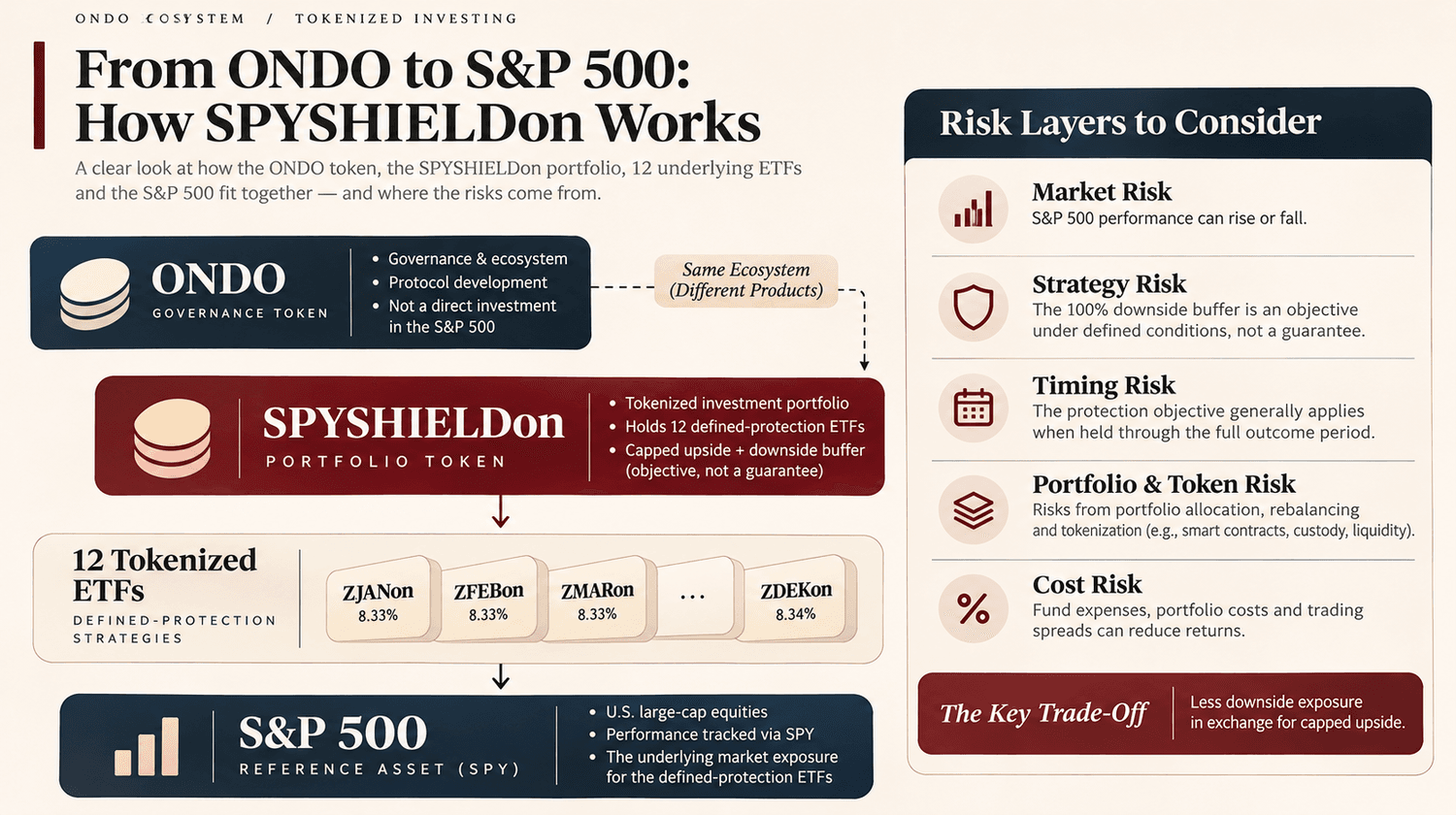
ONDO is the ecosystem's governance token. SPYSHIELDon is a separate tokenized portfolio product that references a basket of underlying ETF-linked assets.
Purchasing one should not be confused with directly purchasing the other.
The economic relationship between ONDO token value and additional portfolio assets depends on the protocol's token economics, governance arrangements and whether platform activity produces any specific benefit for token holders.
The launch may improve Ondo's market visibility and demonstrate broader adoption of real-world asset tokenization. However, those developments should not be interpreted as guaranteed mechanisms for increasing ONDO's price.
Potential Impacts on the ONDO Ecosystem
| Development | Potential Benefit | What Remains Uncertain |
|---|---|---|
| New Investment Strategies | Broader product offering | Sustained investor adoption |
| Growing Portfolio TVL | More assets managed through the ecosystem | Future growth rate |
| Multi-Chain Availability | Greater blockchain accessibility | Distribution of actual users |
| Increased RWA Awareness | More interest in tokenized investment products | Conversion into ONDO token demand |
| Greater DeFi Integration | Additional potential token utility | Liquidity, risks and partner adoption |
The investment case for ONDO therefore depends on a broader set of fundamentals than the launch of one portfolio token.
Investors should evaluate adoption, token economics, regulatory developments and the performance of Ondo's wider infrastructure.
WEEX previously explored this distinction in Does Buying ONDO Mean Investing in OpenAI? OPAIPon Explained, which examines the difference between holding ONDO and gaining exposure to an underlying tokenized investment product.
Is SPYSHIELDon Available to U.S. Investors?
Ondo states that its Intelligent Portfolios are available to eligible investors outside the United States.
This eligibility requirement should not be overlooked.
Blockchain-based availability does not automatically mean a product can legally be purchased by anyone with an internet connection or a compatible wallet.
Tokenized securities and investment products may be subject to jurisdictional restrictions, investor qualification requirements and other applicable terms.
Investors should review the official eligibility criteria and product documentation before attempting to access SPYSHIELDon or other Ondo portfolio tokens.
It is also important to distinguish the availability of a tokenized portfolio through Ondo from the availability of the ONDO governance token on a cryptocurrency exchange.
These are separate products with different purposes.
What Should Investors Watch After the SPYSHIELDon Launch?
The first important indicator will be adoption of SPYSHIELDon itself.
Ondo has provided a combined Intelligent Portfolios TVL figure, but future disclosures may offer additional details about deposits, redemptions and individual portfolio activity.
The second is the performance of the strategy during changing equity-market conditions. Investors can examine whether the portfolio behaves as intended when the S&P 500 rises sharply, remains range-bound or experiences a significant correction.
The third is the relationship between target portfolio weights and actual holdings. Rebalancing can help maintain the intended allocation, but the results depend on market conditions and implementation.
The fourth is liquidity. A tokenized investment product may offer convenient transfers, but the ability to execute transactions at reasonable prices depends on supported venues and available market depth.
Finally, investors should monitor how the product handles its staggered outcome periods and communicates the relevant upside caps and buffers.
These measures are more useful for evaluating the portfolio's long-term prospects than assuming a protection percentage guarantees a particular return.
How to Buy and Trade Ondo (ONDO) on WEEX
WEEX provides ONDO spot and perpetual futures market interfaces for eligible users. Importantly, trading ONDO on WEEX does not mean purchasing SPYSHIELDon or obtaining exposure to the defined-protection ETF strategy.
Step 1: Register on WEEX and Prepare USDT
Visit the WEEX official website and sign in or create an account.
Complete any applicable verification requirements and prepare a USDT balance through a supported funding method. Before depositing digital assets, confirm the appropriate network, deposit details and applicable fees.
Step 2: Open the ONDO Spot Trading Page
Navigate to ONDO/USDT Spot Trading.
Review the current market price, available balance, order book and supported trading options. Choose an eligible market or limit order, enter the intended amount, and examine the estimated transaction costs before confirming.
This market concerns ONDO tokens, not the SPYSHIELDon structured portfolio.
Step 3: Confirm the Trade and Monitor Your Position
After the order is executed, review the transaction history and account balance.
Users interested in derivatives may separately examine ONDO/USDT Perpetual Futures, subject to current trading availability and account eligibility.
The futures interface may display circuit-breaker restrictions, so users should verify whether opening and closing positions are currently permitted. Perpetual futures also introduce leverage, funding payments, margin and liquidation risks.
Investors specifically interested in SPYSHIELDon should consult Ondo's official portfolio documentation and eligibility requirements rather than assuming the portfolio is listed on WEEX.
Conclusion
Ondo's November 17 launch of SPYSHIELDon introduces a new approach to tokenized S&P 500 exposure through a portfolio of 12 defined-protection ETFs.
The strategy seeks to combine capped participation in stock-market gains with conditional downside buffers, while using staggered outcome periods to diversify the timing of its underlying positions.
However, the advertised 100% downside buffer should not be interpreted as an unconditional guarantee of principal. The underlying protection objectives depend on holding-period rules, market conditions and applicable fees, while the tokenized portfolio introduces additional structural considerations.
The launch also expands Ondo Intelligent Portfolios to eight strategies and follows the product line's growth beyond $75 million in TVL.
For investors evaluating SPYSHIELDon, the most important questions concern the actual protection conditions, upside caps, liquidity, fees and future performance. For ONDO holders, the relevant question is whether continued growth in Ondo's tokenized investment ecosystem translates into sustainable long-term adoption.
FAQ
1. What is Ondo SPYSHIELDon?
SPYSHIELDon is the Ondo US 500 Capital Shielded Portfolio, launched on November 17, 2026. It packages 12 tokenized defined-protection ETFs into one portfolio token, seeking capped exposure to S&P 500 gains and buffers against qualifying losses under specified conditions.
2. Does SPYSHIELDon guarantee that investors cannot lose money?
No. The 100% downside buffer refers to the objectives of the underlying defined-protection ETFs over their specified outcome periods, generally before fees and expenses. It does not guarantee that an investor buying or selling SPYSHIELDon at any time will avoid losses.
3. Why does SPYSHIELDon use 12 ETFs instead of one?
The portfolio spreads its holdings across 12 ETFs with staggered outcome periods. This approach diversifies the timing of the underlying protection structures and upside caps, aiming for a smoother return path than concentrating exposure in a single outcome period.
4. Is SPYSHIELDon the same as the ONDO cryptocurrency?
No. SPYSHIELDon is a tokenized portfolio product providing exposure to a defined investment strategy. ONDO is a separate governance token. Buying ONDO does not provide ownership of the SPYSHIELDon portfolio or its underlying ETFs.
5. Can U.S. investors buy SPYSHIELDon?
Ondo states that its Intelligent Portfolios are available to eligible investors outside the United States. Product eligibility and applicable restrictions should be verified through Ondo's official documentation before attempting to invest.
This content is provided for general informational purposes only and doesn't constitute financial, investment, legal, or tax advice. Any events, rewards, online promotions, or related information mentioned herein should not be considered a recommendation, solicitation, or invitation to purchase, sell, trade, or otherwise deal in any crypto assets. Crypto assets are highly volatile and may result in loss. The availability of WEEX services, products, and related events may vary by region. You are responsible for ensuring that your participation is in accordance with applicable local laws and regulations.
You may also like
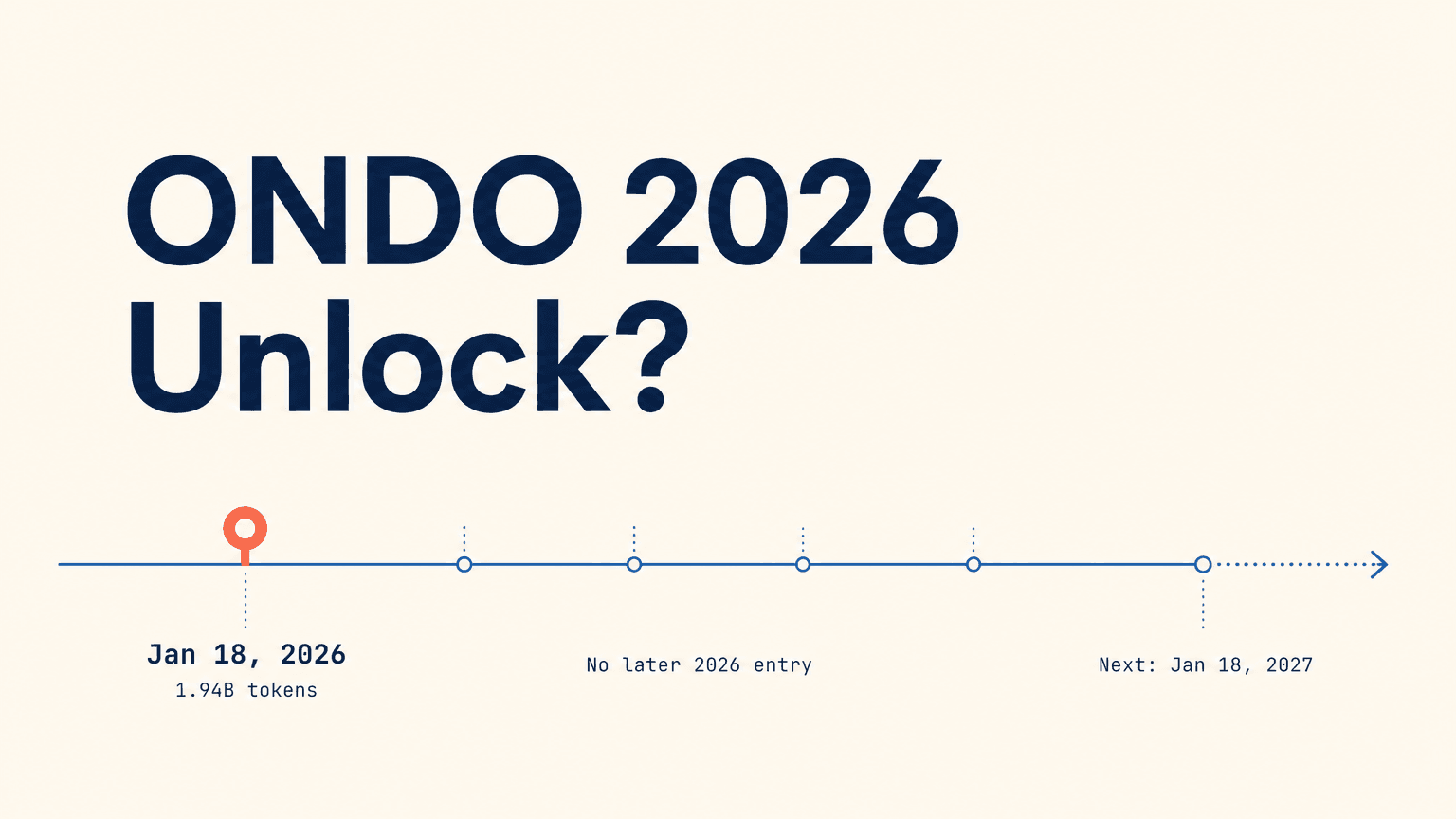
ONDO Token Unlock Schedule 2026: Is There Another Unlock This Year?

BlackRock and Ondo's Tokenized Portfolios vs Traditional ETFs: What Actually Changes

What Is Degen (DEGEN)? WEEX Spot Market
What Is FOREVERS (FRVRS)? WEEX Spot Market
What Is Loopring (LRC)? Shutdown in 2026 and the WEEX Spot Market
What Is Clearpool (CLEAR)? WEEX Spot Market
What Is Drift Protocol (DRIFT)? WEEX Futures and Spot Markets
Tether Backs SCRYPT: Could USDT Become the New Rail for Global Payments?
Bitcoin ETFs Bleed $582M as BTC Slips Below $62K: Is $60K Next?
Polygon's Purley Hard Fork Is Live: What Changes for POL and Network Security?
AMZN Stock Up 3.8%, Then Down 3.9%: Is the AWS AI News Priced In?
Bitcoin Lightning Network for Beginners: 5 Things to Know Before Your First Payment
Anthropic Stock Price (ANT): First-Day Close at $97.17 and What Comes Next
ANT Stock Price Prediction: What the Data Can and Cannot Tell You After Day One
Anthropic IPO vs SpaceX IPO: Price, Raise Size and First-Day Performance Compared
What Is ARUS WORLD (ARUS)? WEEX Spot Market
What Is CZR Token (CZR)? WEEX Spot Market

What Is Creditcoin (CTC)? WEEX Spot Market
Ethereum Below $1,800: 7 Weeks of ETF Outflows and the Next Floor
Binance Hack Update: $2.85B of $6.3B Frozen, Dec. 1 Court Test
XRP Under $1: What the Dec. 1 Escrow Unlock Means for Price
Anthropic Stock After Day One: Why ANT Tokens Trade Near $92
Bitcoin Below $62K: Is $60,000 Next Before the Dec. 9 Fed Call?

What Is GoMining (GOMINING)? The Token and WEEX Spot Market
What Is Koma Inu (KOMA)? WEEX Spot and Futures Markets
How to Use WalletConnect: Check the Channel Before You Approve a Session

What Is ACH? Alchemy Pay's Token and Two ACH/USDT Order Books on WEEX

What Is Vaulta (A)? Project Identity and WEEX Markets
WEEX Staking Rates: Every Coin, Tier and Term (November 2026)

Anthropic's $81.3B IPO: Is ANT Stock Overvalued at $83?
ONDO Token Unlock Schedule 2026: Is There Another Unlock This Year?
BlackRock and Ondo's Tokenized Portfolios vs Traditional ETFs: What Actually Changes
What Is Degen (DEGEN)? WEEX Spot Market
What Is FOREVERS (FRVRS)? WEEX Spot Market
What Is Loopring (LRC)? Shutdown in 2026 and the WEEX Spot Market
What Is Clearpool (CLEAR)? WEEX Spot Market





