
Musk's SpaceX Stake: 48.4% Equity vs 82.4% Voting Power

 Prefer us on Google

Elon Musk's ownership of SpaceX gets reported as five different numbers — 42%, 48.4%, 79%, 82.4%, 85.1% — and all five have been accurate at some point in 2026. They measure different things. Two of them are equity. Three are votes. One is pre-IPO and stale. Getting them confused is how people misread the single most important fact about SPCX as a traded instrument: this is a $1.85 trillion company where the founder cannot be removed, and where the majority of the share count is still working its way onto the market.
SpaceX priced its IPO at $135 on June 11, 2026 and began trading on Nasdaq under SPCX the following day, raising roughly $75 billion at a $1.77 trillion valuation — the largest IPO on record. The stock opened at $150, closed day one at $160.95, peaked at $225.64 on June 16, then fell to an all-time low of $104.83 on August 3. As of August 16, 2026 it traded around $140.00, with a market capitalization near $1.85 trillion as of August 14. The SPCX perpetual on WEEX's futures market was marking 142.55 as of August 17, 2026.
That round trip from $225 to $105 and back toward $140 was not a change in the business. It was the ownership table unwinding on schedule.
How much of SpaceX does Elon Musk own?
Per the Schedule 13G reporting his position as of June 30, 2026, Musk beneficially owns approximately 6.42 billion shares, or 48.4% of SpaceX on a beneficial-ownership basis. That figure breaks down as:
| Component | Shares | Notes |
|---|---|---|
| Class A held in trusts | 849.5 million | 1 vote per share |
| Class B held in trusts | 3.92 billion | 10 votes per share |
| Restricted Class B held directly | 1.30 billion | Performance-vesting |
| Class B options | 350 million | Exercisable within 60 days |
| Total beneficial | ~6.42 billion | 48.4% |
The caveat matters more than the headline. Musk himself flagged that "a bunch of it only vests on extremely crazy good outcomes for SpaceX, so actual full vested percentage is lower." Beneficial ownership under SEC rules counts options exercisable within 60 days and restricted stock the holder can vote — it is a control measure, not a wealth measure. Analyses that strip out the unvested performance awards land closer to 42% as the fully-vested economic stake. At $140 a share, the beneficial figure is worth roughly $900 billion; the vested slice is materially smaller and contingent on milestones tied to multi-trillion-dollar valuation targets and Mars program progress.
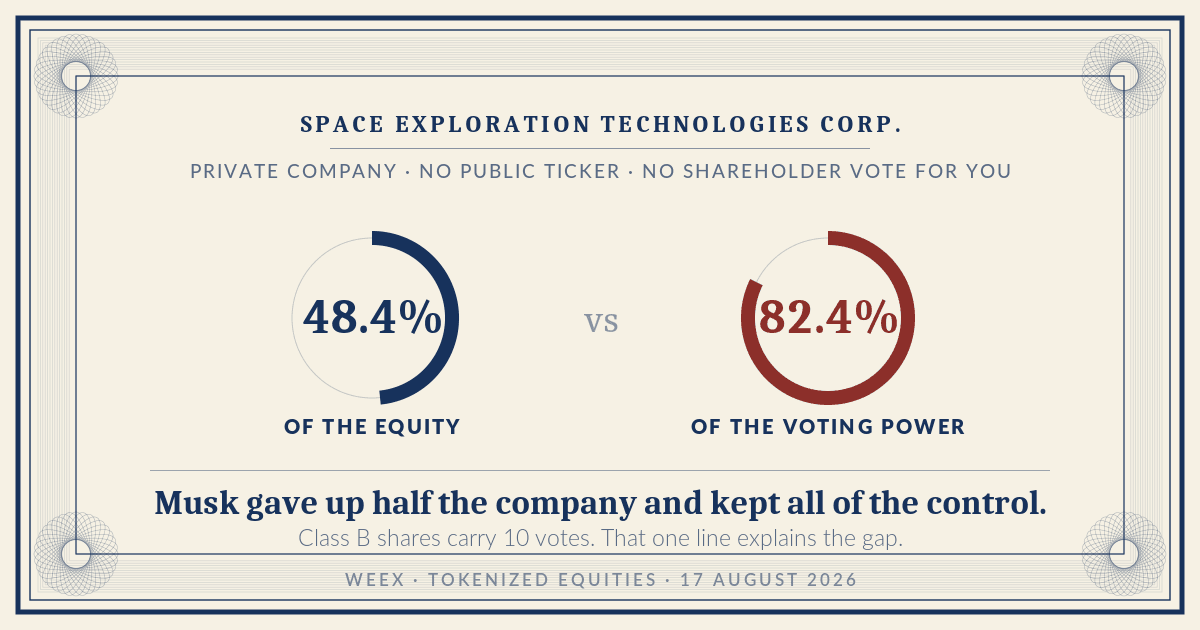
So: 48.4% is what he controls, ~42% is closer to what he owns outright today, and the gap between them is a compensation package that only pays out if the stock does something extraordinary.
Why 48.4% of the equity buys 82.4% of the votes
SpaceX runs a dual-class structure. Class A carries one vote; Class B carries ten. Musk holds 12.3% of the Class A shares and 93.6% of the Class B shares, and that Class B concentration is where the leverage comes from.
The S-1 filed May 20, 2026 showed him at 85.1% of total voting power. The amended S-1/A filed June 3, 2026 — which accounted for the shares actually being sold into the offering — put post-IPO voting power at 82.4%. Both are correct for their respective dates. The 79% figure circulating in some ownership breakdowns is a third cut, typically excluding option shares. The direction of travel is what matters: dilution from the IPO cost Musk under three points of voting power against a $75 billion raise.
The practical consequence is written into the charter rather than left to convention. Removing Musk as CEO or chairman requires a majority of Class B shares. He holds 93.6% of them. He is, structurally, the only person who can vote himself out.
SpaceX also incorporated in Texas rather than Delaware, and the S-1 explicitly discloses that Class A holders will not receive the protections available at companies following all standard Nasdaq governance requirements. The company has additionally limited shareholder ability to bring certain legal challenges. None of this is hidden — it is in the risk factors — but it means the usual activist-investor pressure valve does not exist here. The Council of Institutional Investors wrote to Musk on June 9, 2026 objecting to exactly this.
For a longer treatment of the governance mechanics, WEEX's post-IPO voting control breakdown covers the Class A/Class B comparison against Alphabet and Meta.
Who else owns SpaceX stock
Musk is not the only large holder, but no other single shareholder is close.
| Holder | Approximate stake | Origin |
|---|---|---|
| Elon Musk | 48.4% beneficial / 82.4% of votes | Founder, Class B concentration |
| Alphabet | ~7% | $900M of the $1B January 2015 round (Fidelity took the balance) |
| Founders Fund | Multi-billion position | $20M check in the 2008 Series C, now valued near $50B |
| Employees | ~5% direct share program at IPO | Plus pre-IPO equity grants |
| Public float | 639M shares at IPO, 1.55B post-August 6 | Class A only |
Two structural notes. First, Alphabet's ~7% makes Google's parent the largest outside shareholder in the company — a position that came from a single 2015 check and now sits inside a business that competes with parts of Alphabet's own infrastructure ambitions. Second, buying SPCX today is not a pure launch-services bet: SpaceX acquired xAI in an all-stock deal completed in early 2026, so Class A holders own the Grok models and the X platform alongside Falcon, Starship and Starlink. Starlink, meanwhile, has become the revenue engine — it produced $11.4 billion in 2025, roughly 61% of SpaceX's $18.7 billion total, with 2026 forecasts running from $15.9 billion to $18.7 billion.
-- Price
What Musk's locked shares mean for SPCX supply into 2027
This is the part of the ownership question that actually moved the price, and the part most coverage of the "48.4%" headline skips.
Ownership percentages describe who holds shares. The unlock schedule describes when those shares can be sold. SpaceX staggered its lock-up rather than releasing everything at the standard 180-day mark, which spread the supply over roughly five months.
| Date | Shares becoming eligible | Effect |
|---|---|---|
| June 12, 2026 | 639 million (IPO float) | Initial tradable base |
| August 6, 2026 | ~911.5 million | Float more than doubled to ~1.55 billion |
| August 20, 2026 | ~319 million | Second tranche |
| September 2026 | ~700 million | Third tranche |
| October 2026 | ~700 million | Fourth tranche |
| December 8, 2026 | Balance of 180-day lock-up | Tradable share count approaches ~40% |
| June 12, 2027 | Musk's ~6.4 billion shares | Largest single overhang |
Schedule per company disclosures and reporting as of August 2026; tranche sizes are approximate and subject to change.
The August 6 event is instructive because the market front-ran it and then got the reaction wrong. SPCX bottomed at $104.83 on August 3 — three days before the unlock — then dipped to $105.11 on the morning of the 6th and closed up 2.6% at $111.17. The supply arrived; the selling had already happened. By August 12 the stock was back to $146.15. Anyone who shorted the unlock date itself was late by roughly 72 hours.
The bigger point for anyone holding or trading SPCX into 2027: Musk's 6.4 billion shares are locked until June 12, 2027, and that block is four times the entire current float. Whatever happens at the December 8 expiry, it is not the last supply event. The equity story and the ownership story are the same story here.
What traders usually miss: the tranche dates are published, so they are not edge on their own. The edge, when it exists, is in the positioning ahead of them — funding rates, borrow costs and open interest tend to price the expected sell-off days early, which is precisely why the August 6 print was a bounce rather than a break.
How to get SPCX exposure without a US brokerage account
Buying SPCX directly requires a brokerage that lists US equities, which rules out a large share of the global retail market on residency, KYC or funding grounds. Perpetual futures on tokenized equity exposure are the common workaround, and they behave differently from stock in ways worth stating plainly.
On WEEX, SPCX/USDT is available as a perpetual future under Futures > TradFi, settled in USDT, with leverage up to 100×. There is no share ownership, no dividend, no vote — which, given the 82.4% voting figure above, is a smaller sacrifice for SPCX than for most stocks. What you get is price exposure with 24/7 access; what you take on is funding-rate cost, liquidation risk and the gap between perpetual mark price and the underlying cash equity.
WEEX is running a TradFi promotion alongside this: Global market rewards, a $100,000 prize pool shared across gold and equity futures trading. Key terms as of August 2026:
| Term | Detail |
|---|---|
| Prize pool | $100,000, shared |
| Eligible pairs | All TradFi futures pairs under Futures > TradFi (web and app) |
| "New user" definition | Signs up during the event, or existing user with no prior TradFi trades |
| Excluded volume | Zero-fee TradFi futures volume does not count |
| Guaranteed Price uses | Free uses vary by VIP level |
| Reward timing | Credited within 7 working days after the event ends |
| Stacking | Task rewards calculated independently and can stack |
| Distribution | First-come, first-served while supplies last |
| Not eligible | Market makers and institutional users |
Read the "first-come, first-served" clause literally before sizing a position around it. Promotional volume targets are a well-documented way for newer traders to take leverage they would not otherwise take; the rewards are capped, the liquidation risk is not.
FAQ
1. How much of SpaceX does Elon Musk own in 2026?
48.4% on a beneficial-ownership basis as of June 30, 2026 — about 6.42 billion shares. That includes restricted stock and exercisable options. Excluding unvested performance awards, his fully-vested economic stake is closer to 42%.
2. Does Musk control SpaceX after the IPO?
Yes. He holds 82.4% of voting power post-IPO through 93.6% of the ten-vote Class B shares, and removing him as CEO or chairman requires a Class B majority he alone controls.
3. Why do different sources give different SpaceX ownership percentages?
They measure different things at different dates: 85.1% was pre-IPO voting power per the May 20 S-1, 82.4% is post-IPO voting power per the June 3 S-1/A, 48.4% is beneficial equity, and ~42% is the vested economic stake.
4. When do SpaceX insider shares unlock?
Tranches unlocked on August 6 (~911.5M shares) and August 20 (~319M), with roughly 700M in each of September and October, and the 180-day lock-up expiring December 8, 2026. Musk's ~6.4 billion shares stay locked until June 12, 2027.
5. Can I buy SpaceX stock outside the US?
Direct SPCX purchase requires a broker with US market access. Where that is unavailable, perpetual futures such as SPCX/USDT on WEEX offer price exposure without share ownership, dividends or voting rights.
6. Does owning SPCX mean owning Starlink and xAI?
Yes — Starlink is a SpaceX business line, and SpaceX acquired xAI in an all-stock deal in early 2026, so the listed entity includes Grok and X.
Risk Warning
SPCX is a newly listed equity with an unusually mobile float: the tradable share count more than doubled on August 6, 2026 and continues to expand through December, with Musk's roughly 6.4 billion shares unlocking in June 2027. The stock has traded between $104.83 and $225.64 in its first two months. Concentrated voting control means Class A holders have limited recourse on governance decisions, and Texas incorporation plus charter-level litigation limits narrow that further. Perpetual futures on equity exposure add leverage risk, funding-rate cost, liquidation risk and basis risk against the underlying cash market — at 100× leverage, a 1% adverse move can wipe out margin. Promotional trading events reward volume, which is not the same as rewarding good positions. Crypto and tokenized-equity products are volatile and may result in partial or total loss of capital. Availability of WEEX TradFi products and promotions varies by jurisdiction and user eligibility.
This content is provided for general informational purposes only and doesn't constitute financial, investment, legal, or tax advice. Any events, rewards, online promotions, or related information mentioned herein should not be considered a recommendation, solicitation, or invitation to purchase, sell, trade, or otherwise deal in any crypto assets. Crypto assets are highly volatile and may result in loss. The availability of WEEX services, products, and related events may vary by region. You are responsible for ensuring that your participation is in accordance with applicable local laws and regulations.
You may also like
Ethereum 2030 Roadmap: Vitalik's Cryptographic World Computer
Best Decentralized Crypto Wallet for Beginners: What Self-Custody Really Asks of You

Best Crypto App for Beginners: Exchange App, Wallet App, or Both?
QNT Futures: Funding Rate and Long vs Short After a 4x Rally
Which Crypto to Buy for Beginners: A Simple 3-Tier Starter Plan

Taiwan's Travel Rule Starts in October: What Domestic Crypto Transfers Will Require
WEEX Futures Trading: What 400x Leverage Really Costs You
Is Hyperliquid Safe? Risks You Should Know Before You Trade

What Is Hyperliquid? A Complete Guide to the Perpetuals Exchange
What Is Pi Network? A Complete Beginner's Guide
What Is a Funding Rate? How Perpetual Futures Charge Longs and Shorts
Lighter (LIT) Futures: Cross vs Isolated Margin on a 17% Range
XRP Futures: How to Long or Short XRP After the Clarity Act Vote
What Is ZCAT and Is It Worth Buying? Anonymous Cat (ZCAT) Guide for 2026

MU Stock Reclaims $1,000 Again: What's Actually Different This Time
GPT-6 Astra and Crypto: The AI Token Bid and the Cyber Risk
StonkFun Just Became Solana's Hottest Launchpad: STONK Surges 250% to Prove It

What Is Tangem Wallet? A Complete Beginner's Guide
AAPL Under Ternus: What Apple's CEO Change Means for Traders
PONS Robinhood Chain Token: What the Buyback Rally Rests On
Cathie Wood’s $50 Million Crypto Stock Bet Explained: What Did ARK Invest Buy?
BISCOTTI Crypto: Robot Dog Token Behind Emblem Vault's Debut
Is CyberLeek (CYBERLEEK) Safe? Price Crash and Key Token Risks Explained

CyberLeek Price Prediction 2026: Can CYBERLEEK Recover After the Crash?
Is Crypto Legal in Pakistan? PVARA Rules Traders Must Know
NVIDIA (NVDA) Earnings Date: When Q2 FY2027 Reports and What to Watch
JazzCash P2P Trading: Merchant Vetting, Payment Limits, and the Hidden Account Freeze Risk
Plasma Released 88.89 Million XPL Tokens Today—Why the Allocation Matters
Choosing a Crypto Exchange in Pakistan Before the Sept 5 Deadline
XST Coin Price Prediction: What Happens to AI Narrative Tokens After the Initial Hype Fades
Ethereum 2030 Roadmap: Vitalik's Cryptographic World Computer
Best Decentralized Crypto Wallet for Beginners: What Self-Custody Really Asks of You
Best Crypto App for Beginners: Exchange App, Wallet App, or Both?
QNT Futures: Funding Rate and Long vs Short After a 4x Rally
Which Crypto to Buy for Beginners: A Simple 3-Tier Starter Plan
Taiwan's Travel Rule Starts in October: What Domestic Crypto Transfers Will Require
Contents
Popular coins
Latest articles


