
FUN Token Crash: How a $16K Pool Let a Hacker Sink a 2017 Coin

 Prefer us on Google

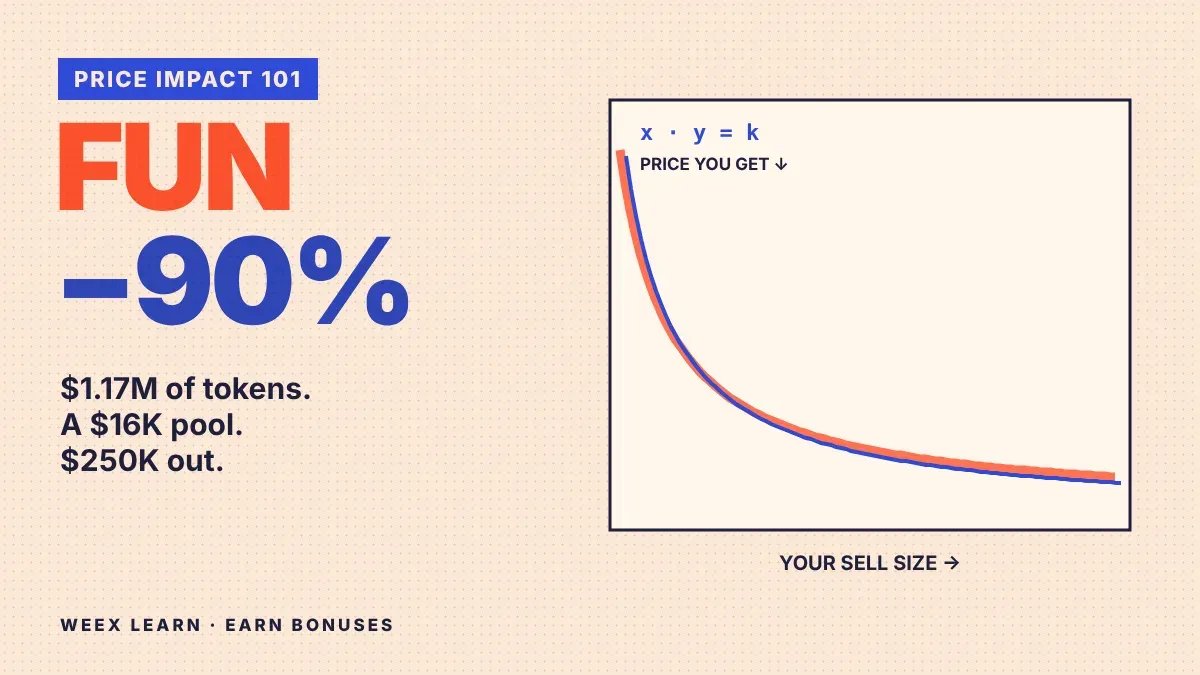
FUNToken (FUN) fell more than 90% on Uniswap overnight from Oct. 29 to Oct. 30, 2026, after the attacker behind the roughly $6.3 billion Binance hack started dumping it. The wallet sold 134.1 million FUN for 111.5 ETH, about $250,000. At the token's previous valuation, those same tokens were worth about $1.17 million. Nearly four-fifths of the value disappeared in the selling itself.
The reason was liquidity. The FUN/WETH pool on Uniswap v2 held only about $16,000 in total, split evenly between FUN and wrapped ether. Selling more than a million dollars' worth of tokens into a pool that small does not find buyers at the market price; it pushes the price down with every trade. Across all markets, FUN finished the day down about 68% on CoinGecko.
FUN is a 2017 project, formerly FunFair, whose token sale raised $26 million in four hours. Its story this week is less about the project than about a mechanic every trader meets eventually: price impact. Below is what happened, how the math works, and how to avoid paying the same tax on your own trades.
How the FUN Dump Unfolded
The timeline from on-chain data, as reported by CoinDesk:
- Oct. 29, 23:28 UTC: the wallet labeled "Binance Hot Wallet Exploiter 2" sent 714.9 million FUN to a fresh address.
- About three minutes later: selling began, almost entirely through Uniswap, with one sale on PancakeSwap.
- Over the next five hours: more than 150 separate sales, the last at 04:17 UTC on Oct. 30.
- After the selling stopped: buyers stepped in and the pool price rose about 75% within an hour.
The pool price fell from about 0.0000037 WETH per FUN to about 0.00000017 WETH. FUNToken asked centralized exchanges to temporarily disable FUN deposits as a precaution, but trading on Uniswap cannot be paused.
The hacker still holds about 580.8 million FUN, roughly 5.4% of max supply, and could sell again at any time. The stolen FUN was worth about 252% of the token's normal daily trading volume, according to Joshua Frank of The Tie.
Price Impact: Why a $16,000 Pool Crashes
Automated market makers like Uniswap v2 price tokens using a fixed formula: the two reserves in the pool, multiplied together, stay constant. When you sell token A into the pool, you add A and remove B, and the price of A falls along a curve.
Here is a simple illustration. Suppose a pool holds $8,000 of FUN and $8,000 of ETH:
- Sell $800 of FUN (10% of that side): you receive about $727. Price impact is roughly 9%.
- Sell $8,000 of FUN (100% of that side): you receive about $4,000. You lose half the value.
- Sell $80,000 of FUN (10 times that side): you receive about $7,270, and the pool is nearly drained of ETH.
That is why splitting the dump into 150 trades did not save the hacker. Arbitrage bots refilled the pool from other venues between sales, but never fast enough to match a seller holding hundreds of times the pool's depth.
How to Avoid Price-Impact Losses on Small Tokens
The same math hits ordinary traders who buy or sell small tokens in size. Before trading a low-liquidity coin:
- Check depth, not just price. On a DEX, look at total pool value. On an exchange, look at how much the order book holds within 1% to 2% of the current price.
- Keep orders small relative to depth. In a constant-product pool, selling an amount equal to 1% of one side costs about 1% in price impact. At 10%, the cost rises to about 9%.
- Set slippage limits. Most DEX interfaces let you cap slippage. A tight limit makes the trade fail instead of filling at a bad price.
- Use limit orders on order-book exchanges. A limit order rests at your price instead of eating through the book. Our guide to why a limit order may not fill shows how to read depth before placing one.
- Watch for large holders. If one wallet owns more than the market can absorb, as the hacker does with FUN, every rally carries that overhang.
-- Price
Is FUN Still at Risk?
Yes, as long as the 580.8 million FUN stays in the attacker's wallet. That stack is still several times the token's daily volume. Other tokens linked to the hack showed the same pattern on a smaller scale, with RSR, RED and GTC down about 17% in the same 24 hours.
The lesson reaches well beyond FUN: small-cap prices are only as solid as the liquidity under them. You can check FUN's current order book on the WEEX FUN/USDT spot market before deciding whether any position size makes sense.
FAQ
1. Why did the FUN token crash 90%?
The Binance hacker sold 134.1 million FUN into a Uniswap pool that held only about $16,000. The sales overwhelmed the pool and pushed the price down more than 90% there, and about 68% across all markets.
2. How much FUN does the Binance hacker still hold?
About 580.8 million FUN, roughly 5.4% of max supply, as of Oct. 30, 2026. Those tokens could be sold at any time.
3. What is price impact in crypto trading?
Price impact is how much your own trade moves the price. In a liquidity pool, the larger your trade relative to the pool, the worse your average price, regardless of the market price before you traded.
4. How can I reduce slippage on small-cap tokens?
Trade small relative to available depth, set a slippage limit on DEX trades, and use limit orders on order-book exchanges so you never fill below a price you choose.
This content is provided for general informational purposes only and doesn't constitute financial, investment, legal, or tax advice. Any events, rewards, online promotions, or related information mentioned herein should not be considered a recommendation, solicitation, or invitation to purchase, sell, trade, or otherwise deal in any crypto assets. Crypto assets are highly volatile and may result in loss. The availability of WEEX services, products, and related events may vary by region. You are responsible for ensuring that your participation is in accordance with applicable local laws and regulations.
You may also like

What Is Degen (DEGEN)? WEEX Spot Market
What Is FOREVERS (FRVRS)? WEEX Spot Market
What Is Loopring (LRC)? Shutdown in 2026 and the WEEX Spot Market
What Is Clearpool (CLEAR)? WEEX Spot Market
What Is Drift Protocol (DRIFT)? WEEX Futures and Spot Markets
Tether Backs SCRYPT: Could USDT Become the New Rail for Global Payments?
Bitcoin ETFs Bleed $582M as BTC Slips Below $62K: Is $60K Next?
Polygon's Purley Hard Fork Is Live: What Changes for POL and Network Security?
AMZN Stock Up 3.8%, Then Down 3.9%: Is the AWS AI News Priced In?
Bitcoin Lightning Network for Beginners: 5 Things to Know Before Your First Payment
Anthropic Stock Price (ANT): First-Day Close at $97.17 and What Comes Next
ANT Stock Price Prediction: What the Data Can and Cannot Tell You After Day One
Anthropic IPO vs SpaceX IPO: Price, Raise Size and First-Day Performance Compared
What Is ARUS WORLD (ARUS)? WEEX Spot Market
What Is CZR Token (CZR)? WEEX Spot Market

What Is Creditcoin (CTC)? WEEX Spot Market
Ethereum Below $1,800: 7 Weeks of ETF Outflows and the Next Floor
Binance Hack Update: $2.85B of $6.3B Frozen, Dec. 1 Court Test
XRP Under $1: What the Dec. 1 Escrow Unlock Means for Price
Anthropic Stock After Day One: Why ANT Tokens Trade Near $92
Bitcoin Below $62K: Is $60,000 Next Before the Dec. 9 Fed Call?

What Is GoMining (GOMINING)? The Token and WEEX Spot Market
What Is Koma Inu (KOMA)? WEEX Spot and Futures Markets
How to Use WalletConnect: Check the Channel Before You Approve a Session
What Is ACH? Alchemy Pay's Token and Two ACH/USDT Order Books on WEEX
What Is Vaulta (A)? Project Identity and WEEX Markets
WEEX Staking Rates: Every Coin, Tier and Term (November 2026)
Anthropic's $81.3B IPO: Is ANT Stock Overvalued at $83?

Micron Stock Drops 3.67% Despite AI Memory Boom: Is MU a Buying Opportunity?

Anthropic IPO Priced at $83: Record $81.3 Billion Raise and What Comes Next
What Is Degen (DEGEN)? WEEX Spot Market
What Is FOREVERS (FRVRS)? WEEX Spot Market
What Is Loopring (LRC)? Shutdown in 2026 and the WEEX Spot Market
What Is Clearpool (CLEAR)? WEEX Spot Market
What Is Drift Protocol (DRIFT)? WEEX Futures and Spot Markets
Tether Backs SCRYPT: Could USDT Become the New Rail for Global Payments?


