
Ethereum Glamsterdam Upgrade Countdown: Can ETH Price Break Out?

 Prefer us on Google


The Ethereum Glamsterdam upgrade activates on the Sepolia testnet on October 6, 2026, at 13:53:36 UTC, the Ethereum Foundation confirmed in its September 17 announcement. It's the first public rehearsal of the network's next hard fork, which brings enshrined proposer-builder separation (ePBS), block-level access lists, and a gas repricing that paves the way for much larger blocks. Mainnet has no date yet. ETH traded around $2,719 on October 2, up roughly 81% from its June low but still about 45% below its August 2025 record. Below: what Glamsterdam changes, when mainnet could realistically arrive, how ETH traded around the last three upgrades, and how to position through the countdown with ETH spot and futures.
What the Glamsterdam Upgrade Changes
Glamsterdam pairs the Amsterdam execution-layer upgrade with the Gloas consensus-layer upgrade and ships 19 EIPs. Three matter most:
- ePBS (EIP-7732). Today, most Ethereum blocks are built by specialized builders and passed to validators through MEV-Boost, an add-on that runs outside the protocol and depends on trusted relays. ePBS moves that handoff into Ethereum itself: the proposer commits to a builder's payload, and the builder reveals it afterward. That removes a trusted middle layer and gives the network more time per slot to propagate and validate data.
- Block-level access lists (EIP-7928). Each block will list every account and storage slot its transactions touch. Clients can then read state and validate transactions in parallel across CPU cores instead of one by one.
- Gas repricing (EIP-8037 and EIP-8038). State creation and state access get new costs that better match their real burden on node hardware, so blocks can grow without bloating the chain's state.
Smaller pieces include standard logs for ETH transfers (EIP-7708) and a new SLOTNUM opcode (EIP-7843).
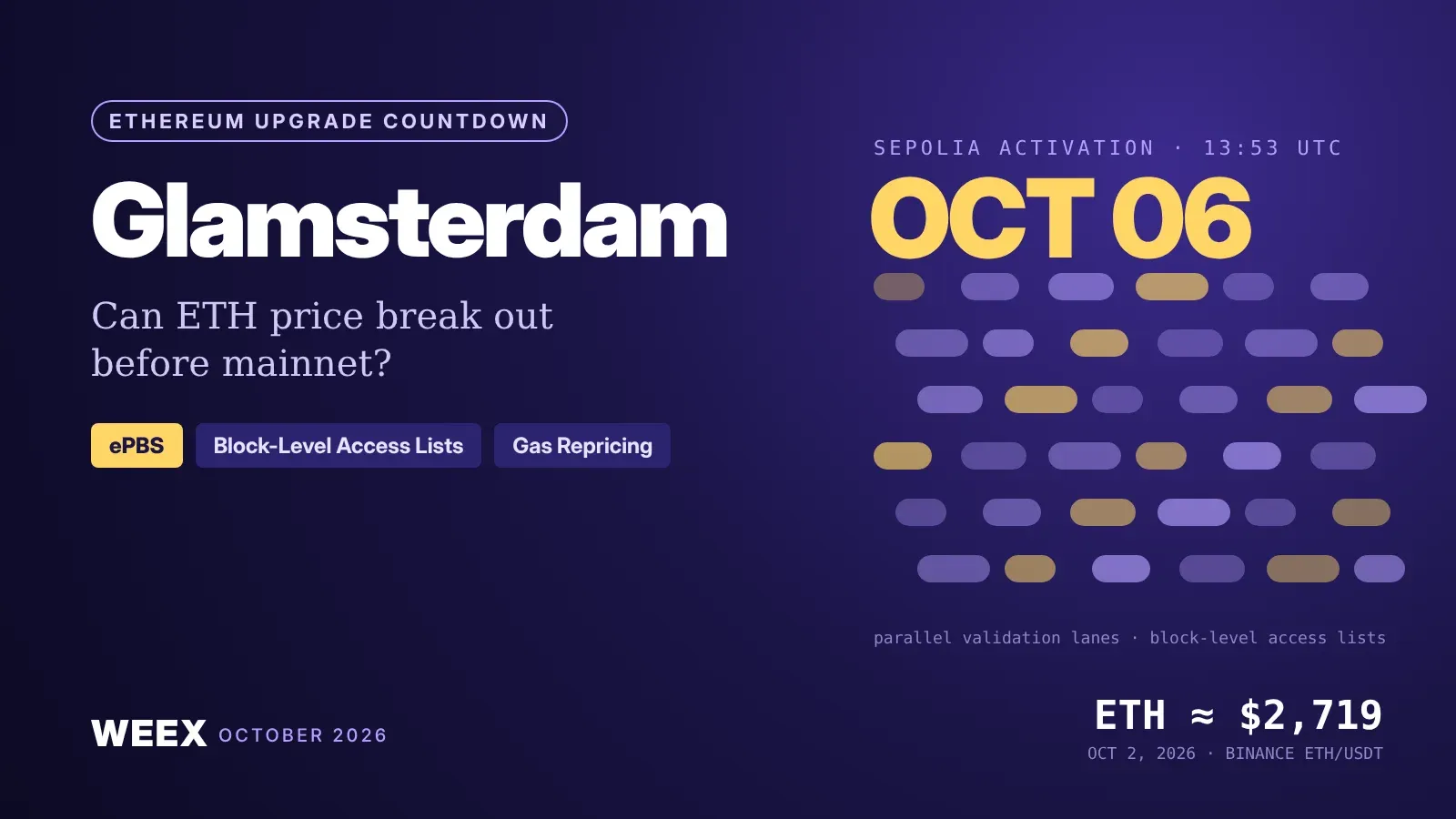
The point of the package: Ethereum's gas limit sits around 60 million today, and core developers have openly discussed a path toward 200 million. Parallel validation and cheaper-to-verify blocks are what make that kind of increase safe. In plain terms, Glamsterdam is a capacity upgrade — more transactions per block on layer 1, with fewer trusted intermediaries in how blocks are built.
Glamsterdam Timeline: From Sepolia to Mainnet
Here's what's confirmed and what isn't, as of October 2, 2026:
- Sepolia: October 6, 2026, epoch 353,024 (slot 11,296,768), 13:53:36 UTC. Confirmed.
- Hoodi testnet: date not yet set.
- Mainnet: not yet scheduled. Client teams will announce it separately.
- Next fork after Glamsterdam: Hegotá, targeted for 2027.
Testnet-to-mainnet gaps give a rough guide. Fusaka hit Sepolia on October 14, 2025 and mainnet on December 3, 2025 — about seven weeks. Pectra reached Sepolia on March 5, 2025 and mainnet on May 7, 2025 — about nine weeks, stretched by testnet problems that forced a fix and an extra test network. If Glamsterdam follows the smoother path, a mainnet date in late 2026 is plausible. If Sepolia or Hoodi exposes bugs, it slips into 2027. Treat any specific mainnet date you see before the client teams announce one as speculation.
For ETH holders on mainnet, the Foundation says no action is needed. Node operators and Sepolia stakers must update both execution and consensus clients before October 6, and developers should check contracts that rely on fixed gas stipends or hardcoded gas limits.
How ETH Traded Around Past Ethereum Upgrades
Upgrades are scheduled events, which makes "buy the upgrade" a popular trade. The record is mixed, based on weekly ETH/USDT prices from TradingView:
- Dencun (mainnet March 13, 2024): ETH hit about $4,094 the week of the upgrade, then fell to roughly $2,852 by mid-April — down about 30%. A clean sell-the-news pattern.
- Pectra (mainnet May 7, 2025): ETH jumped from about $1,809 to $2,515 that week, a 39% gain. But the move coincided with a broad risk-on rally, so the upgrade wasn't the only driver.
- Fusaka (mainnet December 3, 2025): ETH closed that week near $3,060 and drifted sideways, then slid to around $2,270 by late January 2026.
The better reading: upgrades rarely move ETH on their own. Macro conditions and positioning decide whether a scheduled event becomes a launchpad or an exit. And testnet dates, like October 6, have historically mattered far less to price than mainnet dates.
-- Price
ETH Price Into the Glamsterdam Countdown
The setup heading into October:
- Price: about $2,719 on October 2, 2026 (Binance ETH/USDT daily data via TradingView).
- Recent range: roughly $2,356 to $2,807 over the past 40 days, with the high printed on September 21.
- Trend: up about 81% from the June 2026 low near $1,506, after a sharp 31% jump in the week of August 17.
- Long-term context: still about 45% below the all-time high near $4,957 set in August 2025.
Two levels frame the near term. The $2,800 area has capped ETH since late September — a daily close above it would show the upgrade narrative is drawing in fresh buyers. On the downside, the $2,600–$2,650 zone has held repeatedly over the past two weeks; losing it would put the September range low back in view.
What traders usually miss: if Glamsterdam's Sepolia launch goes smoothly, the more meaningful catalyst is the mainnet date announcement, which could come weeks later. A testnet bug, on the other hand, can hit sentiment immediately, as Pectra's testnet issues did in early 2025.
How to Trade ETH Through the Upgrade on WEEX
The choice between spot and futures comes down to time horizon and how much risk you want around a binary-style event.
Spot suits holders who believe Glamsterdam strengthens Ethereum's long-term case. You own the ETH outright, with no liquidation risk and no funding costs. On WEEX, the ETH/USDT spot market is the direct route:
- Fund your WEEX account with USDT.
- Open the ETH/USDT spot pair and choose a limit or market order.
- Consider splitting the buy into tranches around October 6 rather than going all-in before the testnet.
Futures suit traders with a short-term view in either direction. The ETH-USDT perpetual on WEEX lets you go long or short with leverage, which helps if you want to hedge a spot bag or trade a sell-the-news move like Dencun's. A few rules of thumb:
- Keep leverage modest around scheduled events. ETH moved about 6% intraday on September 21; at 20x, a move that size against you wipes out the margin.
- Set a stop-loss before the event, not after.
- Watch the funding rate. When too many traders crowd into longs ahead of an upgrade, funding turns expensive, and that crowding often precedes a flush.
For background on the asset itself, the WEEX Ethereum price page tracks live ETH data and network fundamentals.
Will Glamsterdam Push ETH Higher?
The Ethereum Glamsterdam upgrade is a meaningful technical step. It shrinks Ethereum's dependence on off-protocol block building and lays the groundwork for a much larger layer-1 capacity. That strengthens the long-term case for ETH. The short-term price effect is less certain: past upgrades produced a 39% rally once and a 30% drawdown once, and macro conditions mattered more than the code both times. Watch October 6 for a clean Sepolia launch, then watch for the mainnet date — that announcement, plus a break above $2,800, is the combination that would signal ETH is ready to move. Whatever your view, you can trade ETH spot or futures on WEEX as the Glamsterdam countdown plays out.
FAQ
1. When is the Ethereum Glamsterdam upgrade?
Glamsterdam activates on the Sepolia testnet on October 6, 2026, at 13:53:36 UTC. The Hoodi testnet and mainnet dates haven't been announced yet.
2. What is ePBS in Ethereum?
ePBS, or enshrined proposer-builder separation (EIP-7732), builds the split between block proposers and block builders into Ethereum's protocol, replacing reliance on off-protocol relays like MEV-Boost.
3. Do ETH holders need to do anything for Glamsterdam?
No. The Ethereum Foundation says mainnet users and holders need no action. Only node operators, stakers on testnets, and developers need to update software or check gas assumptions.
4. Will the Glamsterdam upgrade increase ETH price?
Not necessarily. ETH rose about 39% around Pectra's May 2025 launch but fell about 30% after Dencun in March 2024. Market conditions usually matter more than the upgrade itself.
This content is provided for general informational purposes only and doesn't constitute financial, investment, legal, or tax advice. Any events, rewards, online promotions, or related information mentioned herein should not be considered a recommendation, solicitation, or invitation to purchase, sell, trade, or otherwise deal in any crypto assets. Crypto assets are highly volatile and may result in loss. The availability of WEEX services, products, and related events may vary by region. You are responsible for ensuring that your participation is in accordance with applicable local laws and regulations.
You may also like
What Is Coinbase Wrapped Zcash (cbZEC)? How It Brings Zcash to Base Without Native ZEC Privacy
What Is Gno.land (GNOT)? How GnoVM, Storage Deposits, Tokenomics, and GovDAO Work

Phantom Wallet vs MetaMask: What's the Difference
What a Blockchain Explorer Can and Cannot Tell You
How to Look Up a Wallet Address and Transaction History
龙虾 (Lobster) 0 Fee on WEEX: How to Buy Spot and Trade Futures
Circle's Arc Mainnet Is Live: Can It Actually Close the Gap With Tether's USDT?
What Is a Blockchain Explorer and How Does It Work?
Is SafePal Safe? A Look at Its Security Features
What Is SafePal Wallet? A Complete Beginner's Guide
LONGARC Token Explained: Arc Chain Stock Memes, Contract, Risks
What Is Aptos (APT)? Complete Layer-1 Blockchain Guide
HYPE Futures Trading Strategy: Sizing Rules Around Unlocks
Donald Trump Oil Stock Investments: 9 Names, 6 Tradable Now

MetaMask Transaction Stuck or Failed? Here's How to Fix It
XST Stock: Why This Ticker Points to Four Completely Different Companies
What Is Arbitrum (ARB) and How Does This Ethereum Layer 2 Work?
Plasma Released 88.89 Million XPL Tokens Today—Why the Allocation Matters
What Is IMX Crypto? How Immutable's Layer 2 Became the Largest Web3 Gaming Blockchain
ETH to USDT: What the Converter Rate Leaves Out
Pakistan Stock Exchange Performance in 2026: What Is Driving the KSE 100 to Record Highs
What Is Niulai Coin? How a 342 Yuan Chinese Animated Film Spawned a Viral BNB Chain Meme Token
SpaceX Rocket Crashes on the Moon: What It Means for SPCX Traders
TradFi Perpetual Futures API: 26 Symbols and How to Wire Them
WEEX TradFi Trading Fest: Trade Stock Futures and Share 50,000 USDT Rewards
With the World Cup hype building, which tokens are worth keeping an eye on?
What Is Folks Finance (FOLKS)?
Introduction to Canton Network: A New Era for Institutional-Grade Digital Assets
ZKsync (ZK) Price Prediction 2025 – 2030
Plasma (XPL) Price Prediction for 2025, 2026–2030
What Is Coinbase Wrapped Zcash (cbZEC)? How It Brings Zcash to Base Without Native ZEC Privacy
What Is Gno.land (GNOT)? How GnoVM, Storage Deposits, Tokenomics, and GovDAO Work
Phantom Wallet vs MetaMask: What's the Difference
What a Blockchain Explorer Can and Cannot Tell You
How to Look Up a Wallet Address and Transaction History
龙虾 (Lobster) 0 Fee on WEEX: How to Buy Spot and Trade Futures


