
Nvidia Reports $115.8B Revenue After Huang Exit: Can NVDA Justify the AI Hype?

 Prefer us on Google

Nvidia earnings delivered a major test of the AI investment boom on November 17, 2026, as the company reported record quarterly revenue of $115.8 billion, up 103% year over year, and projected approximately $130 billion for the following quarter. The latest Nvidia earnings also marked its first results under interim CEO Colette Kress after Jensen Huang resigned on November 12. Despite powerful data-center growth, investors face questions about future AI spending, declining margin guidance, leadership stability and NVDA's valuation. This analysis examines why Nvidia earnings exceeded expectations, what the numbers reveal about demand, and which risks could shape the stock's next move.
Key Takeaways
- Revenue doubled: Nvidia generated $115.8 billion in fiscal Q3 2027 revenue, up 103% year over year, with data-center revenue reaching $107.6 billion.
- Guidance remained strong: The company expects approximately $130 billion in fiscal Q4 revenue, although the upcoming quarter includes an additional week and gross margins are expected to moderate.
- The investment debate is changing: With Jensen Huang no longer CEO, investors must evaluate whether the company's AI infrastructure growth can justify its valuation and execution risks.
What Were Nvidia's Q3 FY2027 Earnings Results?
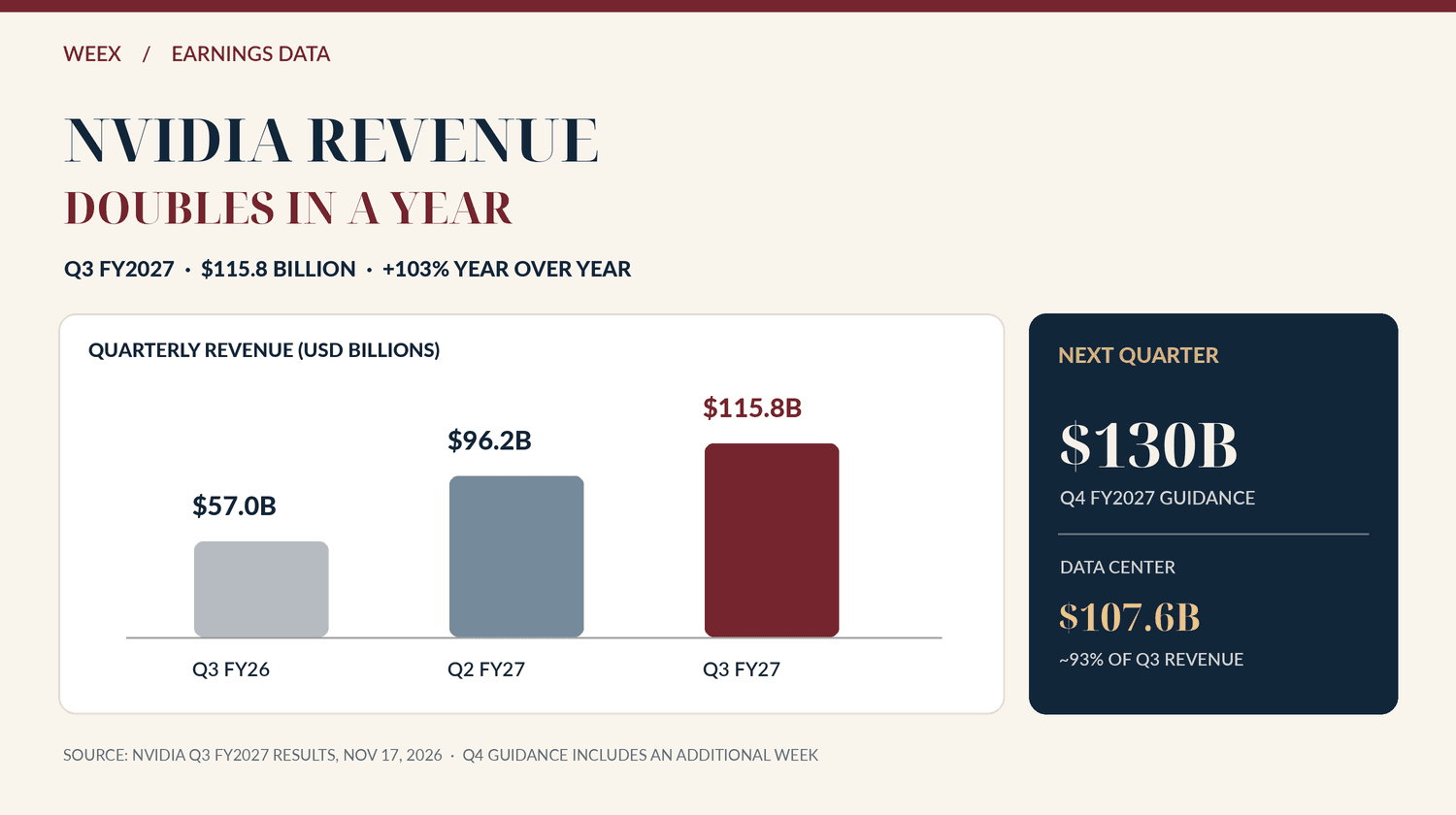
Nvidia reported fiscal third-quarter 2027 results on November 17, covering the quarter ended October 25, 2026. Revenue reached $115.8 billion, compared with $96.2 billion in the previous quarter and approximately $57.0 billion one year earlier.
The increase represents 20% quarter-over-quarter growth and 103% annual growth. For a company already operating at Nvidia's scale, such expansion demonstrates the extraordinary size of current demand for AI computing infrastructure.
Profitability was also substantial. Nvidia reported GAAP net income of $65.3 billion, up 105% year over year, with diluted earnings per share of $2.70. On a non-GAAP basis, diluted earnings were $2.68 per share.
These figures establish that Nvidia's growth is not limited to revenue. However, investors should distinguish current financial performance from expectations for future results, because financial markets frequently price in strong growth before it appears in reported earnings.
Nvidia Q3 FY2027 Financial Results
| Financial Metric | Q3 FY2027 | Q2 FY2027 | Year-over-Year Change |
|---|---|---|---|
| Total Revenue | $115.8B | $96.2B | +103% |
| Data Center Revenue | $107.6B | Approx. $89.0B | +110% |
| GAAP Gross Margin | 74.8% | 75.0% | +1.4 percentage points |
| GAAP Operating Income | $77.5B | $63.7B | +115% |
| GAAP Net Income | $65.3B | $59.7B | +105% |
| GAAP Diluted EPS | $2.70 | $2.46 | +108% |
| Non-GAAP Diluted EPS | $2.68 | $2.22 | +111% |
Sources: Nvidia's official Q3 FY2027 financial release, November 17, 2026, and Q2 FY2027 financial results. All figures are company-reported; percentages are based on unrounded data.
The result also exceeded the company's earlier revenue outlook of approximately $108 billion and the roughly $109 billion level that analysts had expected ahead of the announcement.
This difference matters because Nvidia's exceptionally high growth expectations leave relatively little room for disappointment. The company's ability to exceed them suggests that demand for its computing products remained strong through the reporting period.
For context on expectations before the announcement, see WEEX's Nvidia Earnings Preview: Q3 Results Land Days After Huang's Exit.
Why Is Nvidia's Data Center Business Growing So Quickly?
The most striking number in the earnings report was data-center revenue.
Nvidia generated $107.6 billion from its data-center business during the third quarter, an increase of 110% from the same period a year earlier. This segment accounted for approximately 92.9% of total quarterly revenue.
That concentration shows how dramatically Nvidia's business has shifted toward AI infrastructure.
The company's accelerators, networking technologies and computing systems are central to the development of large AI models and the deployment of inference services. As cloud providers and AI developers expand their infrastructure, Nvidia can benefit from demand across several layers of computing.
Its third-quarter announcement highlighted the beginning of Vera Rubin NVL72 shipments and deployments involving infrastructure providers such as CoreWeave, Microsoft Azure, Google Cloud, Oracle Cloud Infrastructure and Nebius.
These relationships show why the company's earnings are now relevant far beyond the semiconductor industry. A growing portion of spending by cloud infrastructure businesses is tied to hardware and systems needed to train and operate AI applications.
How Important Is Data Center Revenue to Nvidia?
| Indicator | Q3 FY2027 Result | Significance |
|---|---|---|
| Data Center Revenue | $107.6B | Nvidia's largest revenue source |
| Annual Data Center Growth | +110% | Strong demand compared with the prior year |
| Share of Total Revenue | Approximately 92.9% | High exposure to AI infrastructure spending |
| New Platform | Vera Rubin NVL72 | Important product transition |
| Major Customers and Partners | Large cloud and AI infrastructure providers | Broad enterprise and infrastructure demand |
Source: Nvidia's November 17 financial announcement. The revenue share is calculated from $107.6 billion divided by $115.8 billion.
However, the same concentration creates a potential vulnerability.
If AI infrastructure spending slows or large customers shift more workloads toward internally designed chips, Nvidia's growth could become more difficult to sustain.
The key question is no longer simply whether companies want AI computing capacity. It is whether they will continue increasing their purchases at a pace capable of supporting Nvidia's unusually rapid expansion.
What Does Nvidia's $130 Billion Q4 Revenue Forecast Really Mean?
Nvidia expects revenue of approximately $130 billion in its fiscal fourth quarter of 2027, plus or minus 3%.
At the midpoint, this represents about 12.3% sequential growth from its reported third-quarter revenue.
However, two details are essential when interpreting the guidance.
First, Nvidia confirmed that the fourth quarter contains an additional week. The headline revenue increase therefore should not be treated as a direct comparison between two quarters of identical length.
Second, the company said its outlook does not assume data-center computing revenue from China. This suggests that the guidance is based on demand from other markets rather than an anticipated recovery in restricted Chinese chip sales.
Nvidia's Q4 FY2027 Revenue and Margin Outlook
| Metric | Q3 Actual | Q4 Guidance |
|---|---|---|
| Revenue | $115.8B | $130.0B ± 3% |
| Implied Revenue Range | — | $126.1B–$133.9B |
| GAAP Gross Margin | 74.8% | 71.0%–72.0% |
| Non-GAAP Gross Margin | 74.9% | 71.0%–72.0% |
| GAAP Operating Expenses | $9.2B | Approximately $11.0B |
| Quarter Length | Standard reporting quarter | Includes one additional week |
Source: Nvidia Q3 FY2027 Results and Outlook. Revenue range calculated using the company's ±3% guidance.
The revenue outlook is encouraging, but the margin guidance deserves equal attention.
Moving from 74.8% GAAP gross margin in Q3 toward an expected range of 71%–72% in Q4 represents a meaningful decline. The company has not indicated that this decline necessarily reflects weaker demand, and margins can be affected by product mix, manufacturing costs and other factors.
Nevertheless, investors should monitor whether this margin moderation is temporary or becomes part of a longer-term trend.
High revenue growth can coexist with falling profit margins. What ultimately matters for valuation is whether Nvidia can translate continued sales expansion into sustained earnings and cash generation.
-- Price
Why Does Jensen Huang's Departure Matter for NVDA Stock?
Nvidia's latest results carry unusual significance because the company's founder, Jensen Huang, resigned from his executive and board positions on November 12.
Nvidia confirmed that Colette Kress, previously its chief financial officer, became interim CEO while retaining her CFO responsibilities. The company also began the process of identifying permanent leadership.
The departure introduced a new source of uncertainty during an important phase of Nvidia's expansion.
For decades, Huang played a central role in the company's product strategy, developer relationships and long-term direction. His departure does not automatically weaken Nvidia's technology, but it means investors must assess how effectively the organization can maintain strategic continuity without him.
The November Leadership and Earnings Timeline
| Date | Event | Why It Matters |
|---|---|---|
| Nov. 12, 2026 | Jensen Huang resigns from Nvidia leadership | Introduces governance and succession uncertainty |
| Nov. 12, 2026 | Colette Kress becomes interim CEO | Establishes temporary leadership |
| Nov. 17, 2026 | Nvidia reports fiscal Q3 results | Tests the strength of operating performance |
| Nov. 17, 2026 | Nvidia issues $130B Q4 revenue guidance | Provides an updated outlook under interim leadership |
| Upcoming | Permanent CEO selection | Important for longer-term strategy |
Sources: Nvidia's official CEO transition announcement and its November 17 financial release.
The company's earnings demonstrate that major customer demand and product execution continued during the reporting period. However, the quarter largely reflects operations before the leadership change, so it cannot fully establish the longer-term effects of the transition.
Investors will need to watch management appointments, product release schedules, customer relationships and any changes in capital allocation.
For a more detailed examination of the leadership event, see Jensen Huang Resigns as NVIDIA CEO: What Happens to NVDA Stock Next?.
Is Nvidia Proving That the AI Bubble Is Not Bursting?
The results provide strong evidence that spending on AI computing infrastructure remains substantial. They do not, by themselves, prove that every AI-related investment is economically sustainable.
This distinction is central to the debate around an AI investment bubble.
Nvidia sells computing systems to customers investing in future AI products and services. Those sales can increase rapidly even before the customers themselves demonstrate sufficient profits from their AI operations.
For example, a cloud provider may expand data-center capacity in anticipation of future demand. Nvidia recognizes revenue from its products under the applicable accounting rules, but that does not mean every end customer has already earned an attractive return on its infrastructure investment.
This creates two different questions.
The first asks whether Nvidia can sell more AI computing capacity. Its reported financial results strongly support a positive answer for the latest quarter.
The second asks whether the entire AI ecosystem can generate enough long-term revenue to justify continued spending. That question remains open and requires examining customers' financial performance, utilization rates and infrastructure economics.
The AI Investment Debate: Two Different Layers
| Question | Evidence Available | What Remains Uncertain |
|---|---|---|
| Is demand for Nvidia hardware strong? | Revenue and data-center growth | Future growth sustainability |
| Are AI customers spending heavily? | Nvidia's reported sales and deployment announcements | Long-term capital spending levels |
| Are AI services profitable? | Varies by company | Whether returns justify infrastructure costs |
| Will Nvidia retain pricing power? | Strong current margins | Competition and future product economics |
| Can Nvidia's valuation keep expanding? | Depends on earnings expectations | Future growth, risk and market pricing |
This framework explains why Nvidia can publish exceptional earnings while investors still debate its valuation.
A company can be fundamentally strong without its stock being attractively priced at every moment.
Can Vera Rubin Keep Nvidia Ahead of AI Chip Competitors?
Nvidia's Vera Rubin platform is a major element of its next growth phase.
The company highlighted shipments of Vera Rubin NVL72 systems in the third quarter and continued work with large cloud infrastructure customers.
Its strategy combines chips, networking, software and integrated computing systems rather than competing only on individual processor specifications.
That approach can create advantages because enterprise customers evaluate the performance and reliability of entire infrastructure deployments.
However, competition is becoming more complicated.
Large cloud providers are investing in custom chips, while semiconductor competitors continue improving their accelerator products and software ecosystems. Buyers increasingly evaluate total cost of ownership, power consumption, deployment speed and performance for particular AI workloads.
Nvidia's success will therefore depend on more than announcing faster processors. It must continue providing products that deliver economic value to customers compared with alternative systems.
Vera Rubin's adoption offers one potential indicator, but future customer purchases, utilization and margins will be more informative than the product launch alone.
Could Nvidia Stock Still Fall After Strong Earnings?
Yes. Strong earnings do not guarantee a higher stock price.
The market reaction depends partly on how actual results compare with what investors had already expected. Nvidia's exceptional growth means its stock can be especially sensitive to changes in assumptions about future revenue, profitability and AI capital spending.
Several risks remain relevant.
Valuation risk: If the stock already reflects aggressive future growth expectations, even excellent results may not be enough to drive a sustained rally.
Margin pressure: The Q4 gross margin outlook is below the Q3 result, making profitability an important area to monitor.
Leadership uncertainty: Nvidia is operating under interim leadership, and investors do not yet have a complete picture of its permanent succession plan.
Customer investment cycles: AI infrastructure demand depends partly on large technology companies continuing to fund data-center expansion.
Competition and export restrictions: Custom chips, competing accelerators and international trade restrictions could affect Nvidia's future product mix and available markets.
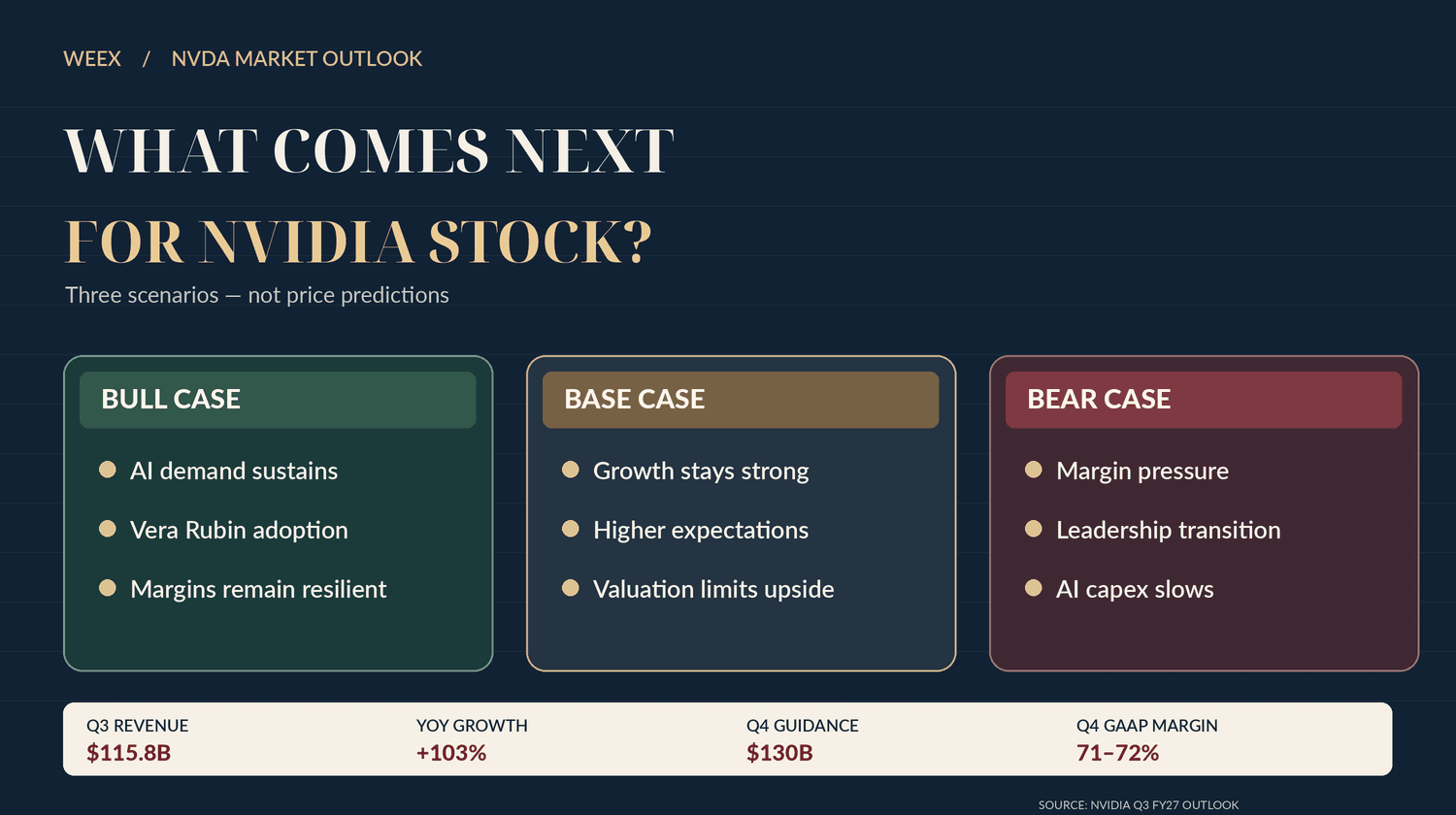
Three Possible NVDA Stock Scenarios
| Scenario | Potential Catalyst | What Investors Should Watch |
|---|---|---|
| Bullish | Strong AI demand and successful Vera Rubin adoption | Customer deployments, future guidance and margins |
| Neutral | Growth remains high but expectations are already priced in | Valuation, revenue growth and capital spending |
| Bearish | Margins weaken or customer investment slows | Guidance revisions, leadership risks and competition |
These are analytical scenarios rather than forecasts of specific future stock prices.
What Should Investors Watch After Nvidia's Earnings?
The next several quarters will provide more information about whether Nvidia's current growth can continue.
Future revenue guidance will remain important, but changes in margins may reveal more about pricing power and product costs.
Progress in Vera Rubin deployments will also help investors determine whether customer demand continues to translate into actual hardware adoption.
At the management level, the selection of a permanent CEO will be an important governance milestone.
Finally, investors should monitor how AI infrastructure customers report their own spending, revenue and profitability. Nvidia's financial performance is closely connected to the economic decisions of these customers.
Readers following the broader earnings calendar can use the WEEX U.S. Stock Token Earnings Calendar to compare upcoming events across stock-linked markets.
How to View and Trade Nvidia (NVDA) on WEEX
WEEX provides Nvidia-related stock-linked trading and USDT-margined perpetual futures interfaces for eligible users. These products are distinct from directly owning registered Nvidia common shares through a traditional brokerage.
Step 1: Register and Prepare Your WEEX Account
Visit WEEX and sign in or register an account. Complete any applicable verification requirements and prepare a supported trading balance.
Before depositing funds, review the available funding methods, deposit networks, product eligibility and applicable transaction costs.
Step 2: Open the NVDA Stock-Linked Trading Page
Navigate to the WEEX NVDA/USDT stock-linked product page.
Review the displayed reference price, market status, trading rules and available order types. Stock-linked products provide exposure to a referenced stock's price under their applicable terms and should not be confused with direct legal ownership of Nvidia shares or ordinary shareholder voting rights.
For details on how these instruments work, see How to Trade NVIDIA (NVDA) Stock Token with USDT on WEEX.
Step 3: Review the Order and Monitor Your Position
If the product is available for trading, select a supported order type, enter the intended amount and check the execution details before confirming.
Eligible derivatives traders may separately examine NVDAUSDT Perpetual Futures. At the time of checking, the futures interface displayed a circuit-breaker notice, meaning opening and closing positions were restricted while order cancellation remained available. Trading status can change, so users must check the current platform notice.
Perpetual futures also introduce leverage, margin, funding and liquidation risks that do not apply in the same way to an unleveraged spot transaction.
Conclusion
Nvidia's $115.8 billion fiscal third-quarter revenue and $130 billion fourth-quarter outlook demonstrate that demand for its AI computing products remains exceptionally strong.
The company continues to benefit from the expansion of data-center infrastructure, while Vera Rubin represents another opportunity to deepen its position in the AI ecosystem.
However, the report also raises questions that cannot be answered by revenue growth alone. Lower expected gross margins, intense competition, uncertain returns on customer AI spending and the departure of Jensen Huang all deserve attention.
For NVDA investors, the most useful approach is to evaluate future earnings, margins, customer adoption and leadership developments together. Nvidia's latest results strengthen the case for its operating business, but the future stock price will still depend on expectations and valuation.
FAQ
1. How much revenue did Nvidia report in November 2026?
Nvidia reported $115.8 billion in revenue for its fiscal third quarter of 2027, announced on November 17, 2026. Revenue increased 103% from the same period a year earlier.
2. What was Nvidia's data-center revenue in Q3 FY2027?
The company reported $107.6 billion in data-center revenue, an increase of 110% year over year. The segment accounted for approximately 92.9% of total quarterly revenue.
3. Why did Nvidia report earnings without Jensen Huang as CEO?
Jensen Huang resigned as president, CEO and a director on November 12, 2026. Nvidia appointed Colette Kress as interim CEO while continuing the process of selecting permanent leadership.
4. What is Nvidia's revenue forecast for Q4 FY2027?
Nvidia expects approximately $130 billion in quarterly revenue, plus or minus 3%. The company noted that the quarter includes an additional week and that the guidance assumes no data-center computing revenue from China.
5. Will Nvidia stock rise after its strong earnings report?
A stock-price increase is not guaranteed. Nvidia's reported growth was substantial, but future performance will also depend on valuation, profit margins, AI infrastructure demand, competition and leadership execution.
This content is provided for general informational purposes only and doesn't constitute financial, investment, legal, or tax advice. Any events, rewards, online promotions, or related information mentioned herein should not be considered a recommendation, solicitation, or invitation to purchase, sell, trade, or otherwise deal in any crypto assets. Crypto assets are highly volatile and may result in loss. The availability of WEEX services, products, and related events may vary by region. You are responsible for ensuring that your participation is in accordance with applicable local laws and regulations.
You may also like
Nvidia Earnings Date: Nov. 17, 2026 After the Bell, in Every Zone
Nvidia Earnings Preview: Q3 Results Land Days After Huang's Exit

Jensen Huang Resigns as NVIDIA CEO: What Happens to NVDA Stock Next?
Jensen Huang Affair Rumors: What the Alice Huang Report Says
Nvidia Stock This Week: Why NVDA Fell Then Bounced and What AI Funding Worries Mean for Chip Stocks

Nvidia Stock Falls After Microsoft's Maia 300: Is Custom Silicon a Real Threat to NVDA?
NVDA Stock Sits Near Its High While Rivals Are Down 18-32%: What Explains the Gap

What Is WEEX Stock Spot Trading? A Beginner's Guide to US Stock Trading with USDT

AMD vs Nvidia After Q2 Earnings: Which Stock Is the Better Buy?

What Is Degen (DEGEN)? WEEX Spot Market
What Is FOREVERS (FRVRS)? WEEX Spot Market

What Is Loopring (LRC)? Shutdown in 2026 and the WEEX Spot Market
What Is Clearpool (CLEAR)? WEEX Spot Market
What Is Drift Protocol (DRIFT)? WEEX Futures and Spot Markets

Tether Backs SCRYPT: Could USDT Become the New Rail for Global Payments?

Bitcoin ETFs Bleed $582M as BTC Slips Below $62K: Is $60K Next?

Polygon's Purley Hard Fork Is Live: What Changes for POL and Network Security?
AMZN Stock Up 3.8%, Then Down 3.9%: Is the AWS AI News Priced In?

Bitcoin Lightning Network for Beginners: 5 Things to Know Before Your First Payment
Anthropic Stock Price (ANT): First-Day Close at $97.17 and What Comes Next
ANT Stock Price Prediction: What the Data Can and Cannot Tell You After Day One

Anthropic IPO vs SpaceX IPO: Price, Raise Size and First-Day Performance Compared

What Is ARUS WORLD (ARUS)? WEEX Spot Market
What Is CZR Token (CZR)? WEEX Spot Market

What Is Creditcoin (CTC)? WEEX Spot Market

Ethereum Below $1,800: 7 Weeks of ETF Outflows and the Next Floor
Binance Hack Update: $2.85B of $6.3B Frozen, Dec. 1 Court Test
XRP Under $1: What the Dec. 1 Escrow Unlock Means for Price

Anthropic Stock After Day One: Why ANT Tokens Trade Near $92
Bitcoin Below $62K: Is $60,000 Next Before the Dec. 9 Fed Call?
Nvidia Earnings Date: Nov. 17, 2026 After the Bell, in Every Zone
Nvidia Earnings Preview: Q3 Results Land Days After Huang's Exit
Jensen Huang Resigns as NVIDIA CEO: What Happens to NVDA Stock Next?
Jensen Huang Affair Rumors: What the Alice Huang Report Says
Nvidia Stock This Week: Why NVDA Fell Then Bounced and What AI Funding Worries Mean for Chip Stocks
Nvidia Stock Falls After Microsoft's Maia 300: Is Custom Silicon a Real Threat to NVDA?
Contents
Popular coins
Latest articles


